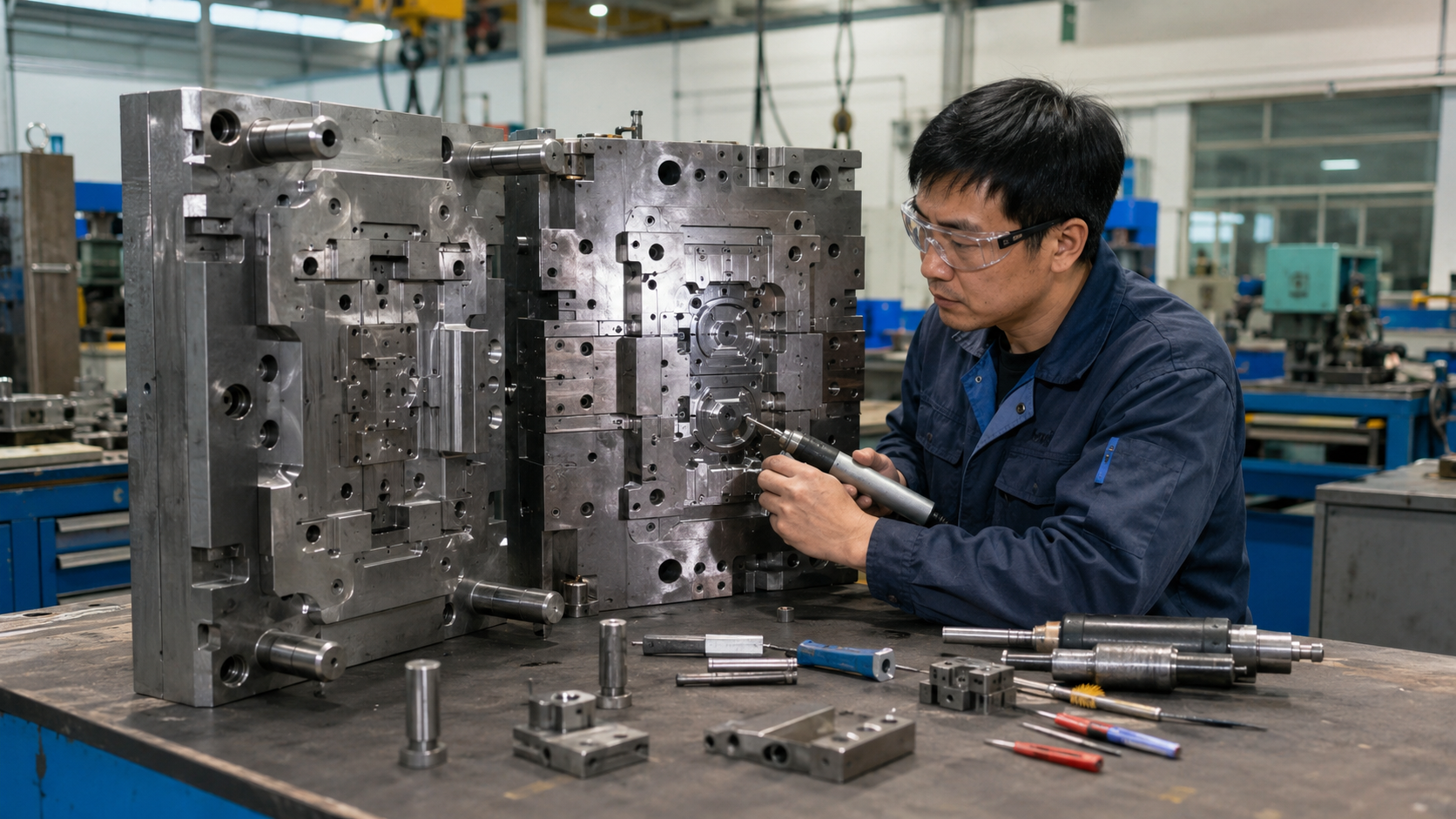
The injection mold repair cost can range from a relatively small machining or polishing job to a major rebuild involving welding, inserts, sliders, hot runner components, and new mold trials.
That is why asking “How much does it cost to repair an injection mold?” without showing the mold condition rarely produces a useful answer.
A worn ejector pin may be straightforward.
A cracked cavity insert, damaged texture, leaking hot runner, or dimensional change across several molded features can turn into a much larger job.
The real cost depends on what failed, why it failed, how much steel must be changed, whether replacement components are needed, and how much validation is required before the mold can return to production.
This guide explains the main factors that affect injection mold repair cost, the difference between repair and modification, and when it may be more practical to build a new mold instead.
What Is Included in Injection Mold Repair Cost?
Injection mold repair is not one single type of work.
It may include correcting wear, replacing damaged components, restoring molded dimensions, repairing surface defects, or modifying the tool because the product design has changed.
Typical repair work includes:
- Replacing ejector pins
- Repairing worn slides
- Replacing guide pins and bushings
- Welding damaged steel
- Re-machining cavity or core areas
- Repairing inserts
- Restoring shut-off surfaces
- Correcting flash
- Repairing water leaks
- Replacing seals
- Servicing hot runner components
- Re-polishing cosmetic surfaces
- Reapplying texture
- Correcting venting
- Replacing springs or wear plates
Modification work is different.
A mold may still be in good condition but require changes because the product design has changed.
Examples include:
- Moving a hole
- Changing a boss
- Increasing a rib thickness
- Adding a snap feature
- Changing a logo
- Adjusting an assembly dimension
- Changing a connector opening
- Modifying a gate
- Changing an insert
These projects often require a different cost calculation because the mold maker is changing the original steel condition rather than simply restoring it.
1. The Type of Damage Has the Biggest Effect on Injection Mold Repair Cost
A repair estimate starts with the actual failure.
Minor wear is usually easier to correct than structural damage.
For example, replacing a standard ejector pin may require relatively little work if the ejector plate and hole are still in good condition.
A damaged cavity surface may require:
- Removing the insert
- Welding the damaged area
- Stress relief if necessary
- Re-machining
- EDM
- Grinding
- Polishing or texturing
- Mold assembly
- Trial molding
The visible defect on the molded part may look small, but the repair behind it can involve several operations.
This is one reason injection mold repair cost should be based on a physical inspection or detailed mold review rather than only a photograph of the molded defect.
2. Welding and Steel Repair Can Increase the Cost Quickly
Welding is common in mold repair and modification.
It may be required when:
- Steel has been cut too deep
- A dimension needs to be reduced
- A sealing surface is damaged
- Flash develops around a worn edge
- A cavity is scratched or dented
- A product feature must be moved
- An insert has cracked
The cost depends on the repair location and steel type.
A simple welding job on a non-cosmetic area may be relatively easy.
Repairing a polished or textured cosmetic cavity is more difficult because the welded area must later match the surrounding surface.
There is also more risk.
Improper welding can cause:
- Hardness variation
- Cracking
- Porosity
- Visible witness marks
- Polishing differences
- Texture mismatch
- Dimensional distortion
For highly cosmetic molds, laser welding may be preferred because it can reduce the heat-affected area.
However, the final cost still includes the machining and surface restoration after welding.
3. Insert Replacement Can Be Cheaper Than Repairing the Original Steel
Not every damaged mold section should be welded.
If the damaged area is already made as a removable insert, replacing that insert may be the better solution.
This is especially useful for areas that experience repeated wear, such as:
- Shut-offs
- Small cores
- Rib inserts
- Gate inserts
- Slide contact surfaces
- Thin steel sections
- High-wear areas
A new insert can sometimes reduce future maintenance cost because the same component can be replaced again without modifying the main cavity or core.
The cost depends on:
- Insert material
- Size
- Required hardness
- Machining complexity
- EDM work
- Grinding
- Surface finish
- Fitting accuracy
For older molds, it is also important to check whether the original insert drawings still match the actual mold.
Years of previous repairs can make the physical tool different from the original design.
4. Slider and Lifter Repairs Are Usually More Expensive Than Standard Wear Parts
Sliders and lifters are moving mold components.
They are often more expensive to repair because a problem may involve several matching surfaces.
Typical slider problems include:
- Excessive clearance
- Worn angle pins
- Damaged guide surfaces
- Seized movement
- Broken springs
- Worn wear plates
- Flash around shut-offs
- Poor return position
Lifter problems may include:
- Bending
- Wear
- Broken tips
- Scratching
- Poor lubrication
- Incorrect timing
A slider cannot always be repaired by replacing one component.
The mold maker may need to inspect the slider body, guide rails, locking surface, angle pin, wear plate, and shut-off relationship together.
That additional fitting work increases injection mold repair cost compared with replacing a standard off-the-shelf component.
5. Cosmetic Surface Repair Can Be More Expensive Than the Steel Work
A cavity may be dimensionally repaired but still fail customer approval because the surface appearance is different.
This is common on:
- High-gloss housings
- Automotive trim
- Consumer electronics
- Transparent parts
- Textured enclosures
- Class-A surfaces
After welding and machining, the repaired area may require:
- Hand polishing
- Mirror polishing
- Stone finishing
- EDM matching
- VDI finish restoration
- Mold-Tech retexturing
- Laser texture repair
Matching an existing texture can be difficult, especially if the mold has already produced many parts and the original texture has worn over time.
In some cases, the entire cavity surface may need to be refinished rather than repairing only one small section.
That can make the surface-finishing portion of the injection mold repair cost higher than expected.
6. Hot Runner Problems Can Change the Repair Budget
Hot runner repairs are a separate category because the mold may include branded electrical and heating components.
Common problems include:
- Heater failure
- Thermocouple failure
- Nozzle leakage
- Valve pin wear
- Manifold leakage
- Damaged seals
- Electrical connector problems
- Blocked flow channels
Replacement components may need to come from the original hot runner supplier.
That means the repair cost may depend on:
- Hot runner brand
- Component availability
- Lead time
- Number of zones
- Valve gate design
- Manifold condition
A simple heater replacement may be straightforward.
A leaking manifold that has allowed plastic to fill the hot runner pocket can require extensive disassembly and cleaning.
If the mold uses a specialized system, always identify the hot runner brand and model when requesting a repair quotation.
7. Product Design Changes Affect Injection Mold Modification Cost
Not every mold modification is caused by damage.
Sometimes the product changes after testing or market feedback.
A customer may ask to:
- Move a hole by 1 mm
- Increase boss diameter
- Reduce wall thickness
- Add a rib
- Remove a snap
- Change a connector opening
- Update a logo
- Increase a sealing surface
The cost depends on whether the requested change requires adding steel or removing steel.
Removing steel is often easier.
Adding steel may require:
- Welding
- New inserts
- Larger replacement inserts
- Major re-machining
For example, enlarging an opening may only require machining.
Making that same opening smaller can be more complicated because material must be added back into the mold.
This is why the CAD change itself does not tell you the actual mold modification cost.
The mold maker needs to compare the new CAD with the current mold steel.
If your project is still before mold manufacturing, our Injection Mold service includes DFM review and mold engineering to reduce expensive corrections after steel cutting.
8. Mold Condition and Age Affect the Repair Decision
A repair should not be evaluated in isolation.
An older mold may have several other areas close to failure.
For example, a customer may ask to repair flash around one cavity, but inspection also reveals:
- Worn leader pins
- Loose ejector system
- Corroded cooling channels
- Damaged sliders
- Water leakage
- Old hot runner components
Repairing only the visible defect may get the mold running again, but another failure may stop production shortly afterward.
For older molds, it is worth requesting a condition report before approving a major repair.
This is especially important when the tool has been running for many years or has been transferred between multiple molding suppliers.
If you are moving an existing tool, our Injection Mold Transfer Checklist explains what buyers should review before shipping a mold to another factory.
9. Mold Trial and Validation Add to Injection Mold Repair Cost
The repair is not complete when the machining is finished.
The mold still needs to prove that the problem has been corrected.
Depending on the repair, validation may include:
- Dry cycling
- Water-pressure testing
- Hot runner testing
- Trial molding
- Dimensional inspection
- Appearance inspection
- Assembly testing
- Process confirmation
A small mechanical repair may only require a short test.
A cavity modification affecting critical dimensions may require a full T1-style mold trial and measurement report.
This testing time should be included when comparing repair quotations.
A repair quote that appears cheaper may exclude trial molding, measurement, material, or sample shipping.
Make sure you know what is actually included.
Typical Injection Mold Repair Cost Ranges
There is no universal price list for mold repair because molds vary greatly in size and complexity.
However, the type of work usually gives a rough indication of whether the job is minor, moderate, or major.
| Repair Type | Typical Cost Level | Main Work |
|---|---|---|
| Standard wear-part replacement | Low | Pins, springs, seals, standard components |
| Minor polishing or vent repair | Low to moderate | Manual finishing, machining |
| Ejector or gate repair | Low to moderate | Parts, machining, fitting |
| Slider or lifter repair | Moderate | Replacement parts, machining, fitting |
| Welding and cavity correction | Moderate to high | Welding, machining, EDM, polishing |
| Insert replacement | Moderate to high | New steel, machining, fitting |
| Hot runner repair | Moderate to high | Components, electrical work, disassembly |
| Cosmetic texture restoration | Moderate to high | Surface preparation and retexturing |
| Major product modification | High | Welding, new inserts, machining, trial |
| Major mold refurbishment | High | Multiple systems repaired or replaced |
The important point is that injection mold repair cost is normally driven by labor, steel work, replacement components, surface finishing, and validation rather than simply the physical size of the damaged area.
Repair, Modify, or Build a New Mold?
Repair is not always the best decision.
A new mold should be considered when:
- The existing mold is near the end of its expected life
- Multiple components are badly worn
- Steel has been welded many times
- Cooling performance is poor
- The original mold design is unstable
- The product has changed substantially
- Spare parts are no longer available
- Production volume has increased significantly
- Repair cost is approaching the cost of replacement tooling
For example, spending 30% of a new mold price on one repair may be reasonable if the rest of the tool is in excellent condition.
Spending the same amount on a mold that has several other serious problems may not be.
The correct comparison is not simply:
repair price vs. new mold price
It should be:
repair cost + remaining mold life + future maintenance risk + production downtime
That gives a more useful business decision.
What Information Should You Send for a Mold Repair Quote?
To get a reliable repair quotation, provide as much of the following as possible:
- Mold drawings
- Current mold CAD
- Part CAD
- Latest 2D drawing
- Photos of the mold
- Photos of the defect
- Mold trial samples
- Dimensional report
- Current molding parameters
- Mold age
- Approximate shot count
- Repair history
- Hot runner information
- Mold steel information
- Required completion date
If the issue is dimensional, clearly identify the actual measurement and target dimension.
If the problem is cosmetic, provide close-up photos under good lighting.
If the mold will be shipped to the repair supplier, confirm the mold weight and overall dimensions as well.
For production projects where tooling and molding need to be handled together, our Injection Molding Production service supports mold validation, process setup, and ongoing part production.
Do Not Approve a Repair Before Understanding the Root Cause
One of the most expensive mistakes is repairing the mold before confirming why the problem occurred.
Flash, for example, may come from:
- Worn steel
- Excessive injection pressure
- Poor mold locking
- Damaged parting surfaces
- Machine platen problems
Warpage may come from:
- Cooling imbalance
- Product design
- Material
- Gate location
- Process settings
A cracked part does not automatically mean the cavity needs modification.
The problem may come from material stress, assembly load, or molding conditions.
Before changing steel, determine whether the problem is actually inside the mold.
Our article on Why Injection Molding Parts Warp After Cooling gives a good example of why molded defects should be traced back to their root cause before modifying tooling.
How to Reduce Future Injection Mold Repair Cost
Most molds will eventually need maintenance.
The goal is not to eliminate repair completely.
The goal is to prevent small problems from becoming expensive failures.
Useful practices include:
- Clean the mold regularly
- Lubricate moving components
- Check cooling circuits
- Inspect slides and lifters
- Replace wear parts before they fail
- Record shot count
- Monitor flash development
- Keep spare critical components
- Store the mold correctly
- Maintain repair records
A repair history is especially useful.
If the same component fails repeatedly, the correct solution may be a design change rather than another replacement.
Conclusion
The injection mold repair cost depends on much more than the visible damage.
Steel condition, welding, inserts, moving components, hot runners, surface finish, mold age, design changes, and validation can all affect the final price.
A small repair may only require a few replacement components.
A major mold modification can involve welding, machining, EDM, polishing, texturing, assembly, and a complete new mold trial.
Before approving a repair, first determine the root cause and evaluate the overall condition of the mold.
If the rest of the tool is healthy, repair or modification may extend its useful life at a reasonable cost.
If the mold is already heavily worn or the product has changed substantially, building a new mold may be the more economical choice over the remaining production life.