Injection mold spare parts are easy to ignore when a new mold is delivered.
Most buyers focus on the mold itself, the samples, dimensions, cycle time, and final acceptance. However, once production starts, a very small worn or broken component can stop the whole mold.
That is why a new mold should normally come with a basic set of spare parts.
The exact list depends on the mold structure, production volume, and material. Still, some wear parts are common enough that buyers should confirm them before shipment.
Why Injection Mold Spare Parts Matter
A mold may run well during the final trial and still need small replacement parts later.
Some components move every cycle. Others work under heat, pressure, friction, or repeated impact.
Over time, parts such as ejector pins, springs, seals, and wear plates may fail before the main mold steel has any serious problem.
If no replacement is available, production may stop for a simple reason.
The factory then has to:
- Measure the damaged part
- Make a new drawing
- Order material
- Machine the replacement
- Fit it into the mold
- Test the mold again
A small component can therefore create several days of delay.
If the supplier already provides the correct spare part, replacement is much faster.
For many production molds, injection mold spare parts are most valuable when they are small, custom-made, and able to stop production if they fail.
Injection Mold Spare Parts Should Match the Mold Structure
There is no single spare-parts list for every mold.
A simple two-plate mold may need only a few basic items.
A mold with sliders, lifters, hot runner components, and complex ejection may need a larger package.
Therefore, the spare-parts list should be based on the actual design.
The supplier should review which parts:
- Move frequently
- Wear faster
- Are difficult to source
- Require custom machining
- Could stop production if they fail
These are usually the parts worth preparing in advance.
A good injection mold spare parts package should focus on components that wear faster than the main mold steel.
Injection Mold Spare Parts for Ejector Pins
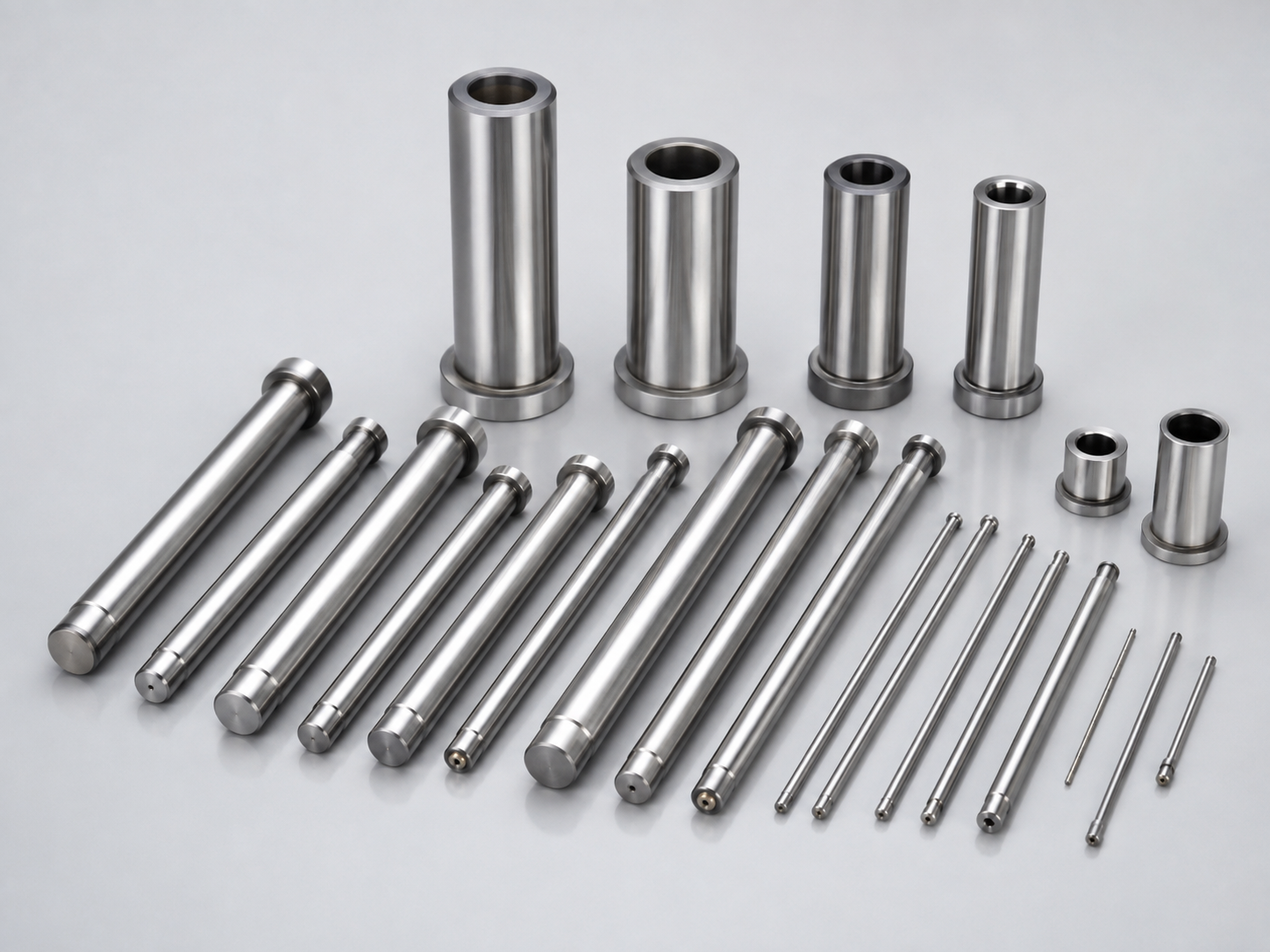
Ejector pins are among the most common wear parts in an injection mold.
They move every cycle and can suffer from:
- Bending
- Surface wear
- Scratching
- Galling
- Breakage
Small ejector pins are especially worth keeping as spares.
If a pin breaks during production, replacing it with a finished spare can be quick.
Without a spare, the factory may need to machine a new pin and match its length, head size, diameter, and surface condition.
For molds with many special ejector pins, the supplier should normally provide at least the more critical sizes.
Ejector Sleeves Should Be Included When They Are Critical
Ejector sleeves are more difficult than standard ejector pins.
They often work around bosses or cylindrical features. Because of this, their fit directly affects part quality.
A worn or damaged sleeve may cause:
- Flash
- Poor ejection
- Scratches
- Dimensional change
- Leakage around the feature
If the sleeve is custom-made, it is worth including a spare.
This is especially true when the sleeve is thin, long, or difficult to machine.
Springs Are Cheap but Important
Springs are simple parts, but they can still stop production.
They may be used in:
- Return systems
- Slides
- Lifters
- Floating plates
- Core mechanisms
Over time, springs can lose force or break.
Because they are inexpensive, buyers should expect spare springs for important positions.
The supplier should also identify the spring specification clearly.
A replacement spring with the wrong force can create new problems.
O-Rings and Seals Should Not Be Forgotten
Cooling and hydraulic systems often use O-rings or other seals.
These parts are cheap, but they age, flatten, harden, or get damaged during maintenance.
A failed seal can cause:
- Water leakage
- Oil leakage
- Cooling loss
- Production interruption
For molds with many inserts or internal cooling connections, spare O-rings are especially useful.
The supplier should provide the correct size and material rather than leaving the buyer to guess later.
Injection Mold Spare Parts for Slides and Lifters
Slides and lifters contain several components that may wear faster than the main mold steel.
Depending on the design, useful spare parts may include:
- Wear plates
- Guide blocks
- Angle pins
- Small inserts
- Locking blocks
- Guide components
Not every slide component needs a spare.
However, parts that are small, custom-made, and easy to replace are worth considering.
If a large slider body fails, the repair may still require machining.
But if a small wear plate or guide block is already prepared, maintenance becomes much easier.
This is also closely related to regular injection mold wear inspection.
Injection Mold Spare Parts for Hot Runner Molds
Hot runner molds usually need a more detailed spare-parts list.
Depending on the hot runner system, the supplier may include:
- Heater bands
- Thermocouples
- Seals
- Nozzle tips
- Valve pins
- Small heaters
- Electrical connectors
These parts can fail during long-term production.
More importantly, some hot runner components are brand-specific.
That means the buyer may not be able to buy a replacement quickly from a local supplier.
For this reason, hot runner injection mold spare parts should be discussed before mold delivery.
Valve Gate Components May Need Backup Parts
Valve gate systems have additional moving components.
Common wear or failure points include:
- Valve pins
- Pin seals
- Bushings
- Cylinder seals
- Small pneumatic or hydraulic components
A bent or worn valve pin can quickly affect gate appearance or filling.
If the project has strict gate requirements, keeping a replacement valve pin is a good idea.
For larger molds, the supplier may also provide the hot runner supplier’s part numbers so future replacements can be ordered correctly.
Small Core Pins Are Worth Preparing
Thin core pins can break.
This is especially common when the part has:
- Small holes
- Deep ribs
- Thin steel conditions
- Long unsupported cores
If a core pin is simple and removable, preparing one or two spares is usually practical.
A spare core pin can save much more time than it costs.
This is particularly useful for high-volume molds.
Custom Inserts Can Be More Valuable Than Standard Parts
Standard parts are usually easier to buy.
Custom inserts are different.
If a small insert has a complicated shape, tight tolerance, or special steel, making a new one later may take much longer.
Therefore, buyers should ask whether any small custom insert is critical enough to justify a spare.
This does not mean duplicating every insert in the mold.
The goal is to identify the few parts that would create long downtime if they failed.
Standard Parts Do Not Always Need to Be Supplied
Not every component needs to come with the mold.
Some standard items may be easy to buy locally.
For example:
- Common screws
- Standard washers
- Standard fittings
- Common springs
- Standard connectors
If the specification is clear and the part is easy to source, a physical spare may not be necessary.
However, the supplier should still provide the correct specification.
This helps the buyer avoid ordering the wrong replacement later.
How to Label Injection Mold Spare Parts
A box of loose spare parts is not enough.
Each part should be easy to identify.
A useful label may include:
- Mold number
- Part name
- Drawing number
- Quantity
- Position
- Material
- Hardness, if important
For example:
Mold M128 – Ejector Pin EP-07 – Qty 2
This is much better than putting several pins into an unmarked plastic bag.
Clear labeling becomes even more important when one factory manages many molds.
Injection Mold Spare Parts Should Match the Final Mold
This point is important.
A mold may change several times during T1, T2, and final approval.
For example:
- An ejector pin may change diameter
- A core pin may change length
- A slider insert may be modified
- A spring may change specification
The spare part should match the final approved mold.
Otherwise, the buyer may receive a spare that no longer fits.
Therefore, the supplier should prepare final spare parts after the mold design and modifications are frozen.
Buyers should also confirm that all injection mold spare parts match the final approved mold design before shipment.
This is also why good injection mold documentation matters at delivery.
A Spare Parts List Should Come With the Mold
Buyers should not rely on memory.
The supplier should provide a simple spare-parts list.
For example:
| Spare Part | Quantity | Drawing/Spec | Position |
|---|---|---|---|
| Ejector pin | 2 | EP-03 | Core side |
| Ejector sleeve | 1 | ES-02 | Core side |
| Spring | 4 | SP-01 | Return system |
| O-ring | 10 | OR-06 | Cooling inserts |
| Core pin | 2 | CP-04 | Cavity area |
| Wear plate | 2 | WP-02 | Slider |
The list does not need to be complicated.
It only needs to be clear.
What Should Buyers Ask Before Mold Shipment?
Before the mold ships, buyers can ask a few simple questions:
- Which parts are expected to wear first?
- Which parts could stop production if they fail?
- Which custom parts are difficult to remake?
- Which spare parts are included?
- Are the spare parts already finished and ready to install?
- Do they match the final mold version?
- Are drawings or specifications provided?
- Are hot runner spare parts included?
- Are all items labeled?
These questions are much more useful than simply asking, “Do you provide spare parts?”
How Many Injection Mold Spare Parts Should Be Supplied?
A low-volume mold and a high-volume mold should not always receive the same spare package.
For a short production run, a basic set may be enough.
For a mold expected to run hundreds of thousands of cycles, more backup parts may make sense.
Production location also matters.
If the mold will run in another country, replacement lead time becomes more important.
For export molds, injection mold spare parts are even more important because making or shipping a replacement part can take much longer.
A part that takes one day to make near the mold supplier may take much longer when the mold is overseas.
Therefore, export molds often benefit from a more complete spare-parts package.
Spare Parts Do Not Replace Good Maintenance
Providing spare parts does not mean the mold can run without maintenance.
The factory still needs to:
- Clean the mold
- Lubricate moving parts
- Check cooling
- Inspect wear
- Replace damaged components early
Spare parts only make maintenance faster when wear occurs.
For long-term injection molding production, both spare parts and regular maintenance are important.
Final Thoughts
Injection mold spare parts are a small part of mold delivery, but they can have a large effect on future downtime.
A new mold should normally include the wear parts and small custom components that are most likely to fail or are difficult to replace quickly.
Common examples include:
- Ejector pins
- Ejector sleeves
- Springs
- O-rings
- Small core pins
- Wear plates
- Selected slider or lifter parts
- Hot runner components
The exact list should match the mold structure and expected production volume.
Most importantly, every spare part should match the final mold version and come with clear identification.
A few well-chosen spare parts cost very little compared with the time lost when a mold stops production and the replacement component has to be made from scratch.