
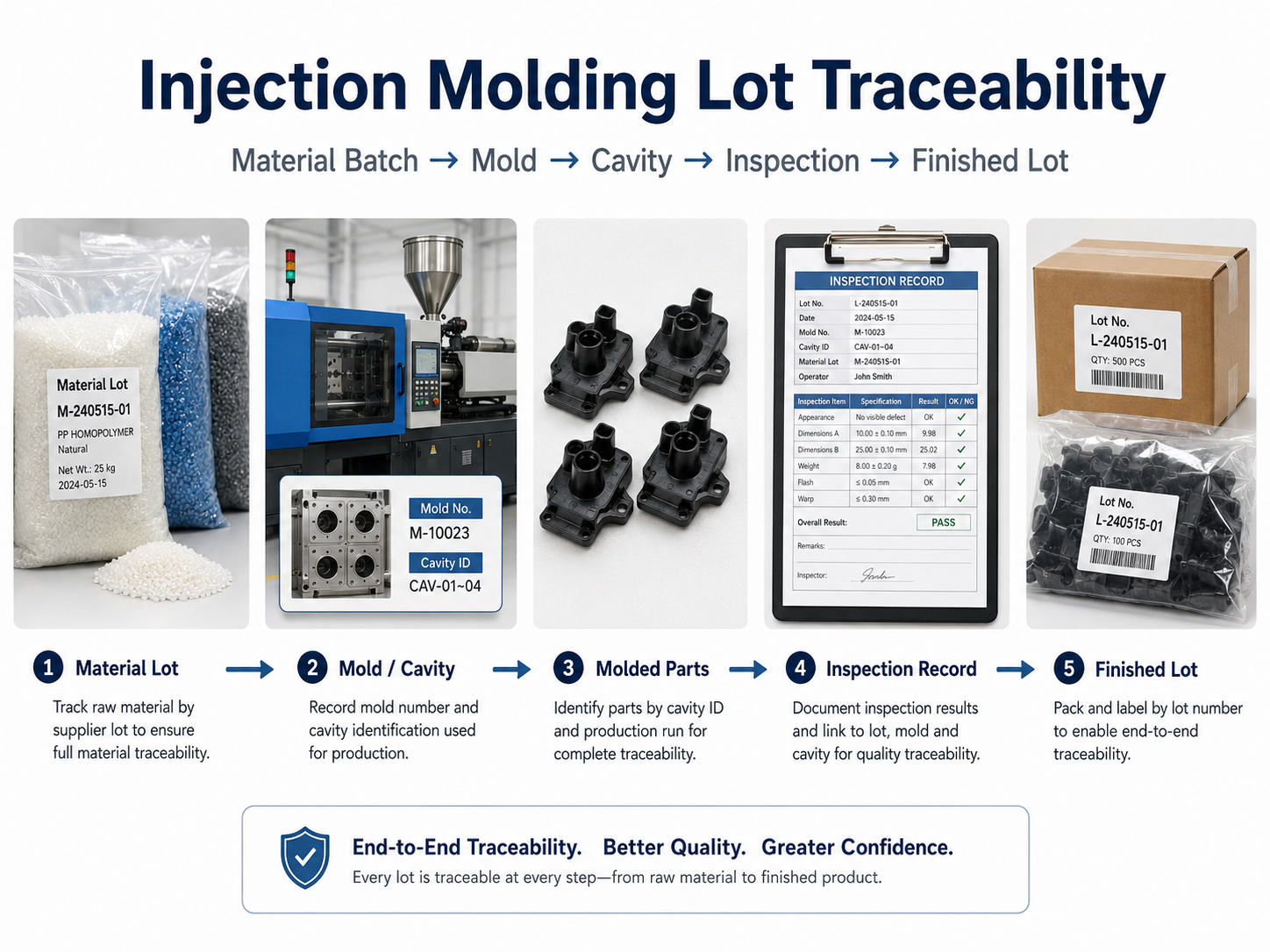
Injection molding lot traceability is more than printing a batch number on a box.
A useful traceability system should answer one simple question:
If a quality problem appears today, can the supplier quickly identify what was produced, when it was produced, which material was used, and which other parts may be affected?
For buyers, this becomes especially important once a project moves into regular production.
A supplier may produce good samples during mold trials. However, long-term production brings more variables. Material batches change. Operators change. Machines may change. Mold maintenance also affects production.
Because of this, good lot traceability helps both sides find the cause faster.
What Is Injection Molding Lot Traceability?
Injection molding lot traceability links finished parts back to the main records from the same production run.
Depending on the project, these records may include:
- Production date
- Production lot number
- Raw material batch
- Material supplier
- Injection molding machine
- Mold number
- Cavity number
- Operator
- Process settings
- Inspection results
- Packaging date
- Rework or deviation records
Not every project needs every item.
For example, a simple plastic cover with loose tolerances may only need a lot number and material record.
However, precision parts, functional parts, medical-related components, and long-term production usually need more detail.
A Lot Number Should Lead to Real Records
Some suppliers put a lot number on every carton.
That looks like traceability.
However, the real question is what happens when someone searches that lot number.
A useful lot number should lead to actual production records.
For example:
Lot: 20260905-A
The supplier should be able to find:
- When the lot was molded
- Which machine ran the job
- Which mold was used
- Which resin batch went into production
- Which process sheet the operator followed
- Which inspection report belongs to the lot
- Whether any abnormal event happened
If the lot number only shows the production date, traceability remains weak.
In other words, the number has little value unless it connects to real records.
Injection Molding Lot Traceability Should Start With Material
Raw material is one of the first records buyers should expect to see.
If a molded part later develops cracking, color variation, dimensional change, or strength problems, the material batch is often one of the first things to check.
A supplier should normally link the finished lot to:
- Material grade
- Manufacturer
- Material batch number
- Color masterbatch
- Additives, if used
- Drying conditions, when important
This is especially useful for materials such as:
- PA
- PC
- PBT
- ABS
- PC+ABS
- Glass-filled materials
- Flame-retardant materials
For hygroscopic plastics, drying records also matter.
For example, if two production lots use different resin batches and only one lot develops a problem, the material record gives the team a clear starting point.
For this reason, injection molding lot traceability should always connect the finished part lot with the exact raw material batch used in production.
Injection Molding Lot Traceability and Production Records
The production date sounds basic, but it helps narrow the investigation quickly.
Suppose a customer reports a defect in parts received in September.
The supplier checks the lot number and finds that the affected parts came from production on August 18.
Now the team can review the correct records instead of searching through months of data.
Machine identification also helps.
For example, the same mold may run on two different injection molding machines during the year.
If defects appear only in lots from one machine, the cause may relate to:
- Check ring condition
- Machine repeatability
- Temperature control
- Injection speed control
- Clamp condition
Without machine information, this pattern becomes much harder to see.
Injection Molding Lot Traceability for Mold and Cavity ID
For multi-cavity molds, production lot information alone may not be enough.
Suppose an 8-cavity mold produces 40,000 parts in one lot.
Only cavity 6 has a dimensional problem.
If the parts are mixed together without cavity identification, the supplier may need to inspect the whole lot.
However, if each part has a cavity ID, the supplier can narrow the problem much faster.
This is why multi-cavity injection molding benefits from cavity-based identification.
Lot traceability tells you which production batch the part came from.
Cavity identification tells you which cavity made it.
Together, these two records make defect tracing much more effective.
Process Records Should Match the Production Lot
A stable process should have an approved production setting.
However, operators may still make small adjustments during production.
For example:
- Injection pressure may change
- Holding pressure may change
- Cooling time may increase
- Mold temperature may move slightly
- Injection speed may change
This does not always mean something is wrong.
In normal production, small adjustments sometimes help keep the process stable.
The important point is whether the supplier records meaningful changes.
If a later quality problem appears, the team should be able to compare the affected lot with earlier stable production.
This is closely related to the injection molding process window.
A supplier with good process control should know which parameter changes remain inside the approved range.
Injection Molding Lot Traceability and Inspection Reports
A dimensional report becomes much more useful when it clearly identifies the production lot.
For example:
Inspection Report: IR-260905-03
Production Lot: 20260905-A
Mold: M-126
Material Lot: PA66-260830-18
Now the records connect.
If a customer later reports an issue, the supplier can find the original inspection data quickly.
For important parts, the report may include:
- Critical dimensions
- Appearance checks
- Part weight
- Functional testing
- Color
- Assembly checks
- Cavity information
Good injection molding lot traceability connects these records instead of storing them as separate files with no clear link.
How to Define Lots for Injection Molding Lot Traceability
A common question is:
What exactly counts as one lot?
There is no single answer for every injection molding project.
A supplier may define a lot by:
- One production day
- One machine setup
- One raw material batch
- One production order
- One shift
- One continuous production run
For example, if production stops and a new resin batch starts the next day, creating a new lot may make sense.
For more critical parts, even a major process interruption may justify a new lot number.
Therefore, the key is consistency.
The supplier should have a clear rule for when one lot ends and another begins.
Injection Molding Lot Traceability Helps Control Material Changes
Material changes can create real risk if nobody records them.
Suppose a drawing specifies a particular PC+ABS grade.
Later, the original material becomes unavailable.
The supplier may suggest another grade.
Even if the new material looks similar, it may change:
- Shrinkage
- Flow
- Strength
- Surface appearance
- Flame rating
- Dimensions
Therefore, approved material changes should remain visible in the records.
The supplier should trace the new material batch and its approval.
If performance changes later, both sides can then identify exactly when the new material entered production.
Rework Should Not Break Traceability
Reworked parts can create problems if they go back into normal production without clear records.
For example, parts may need:
- Trimming
- Secondary machining
- Printing
- Painting
- Assembly correction
- Sorting
If those parts return to the original batch, the supplier should still know what happened to them.
Otherwise, a later defect may become difficult to investigate.
For important products, rework records should normally show:
- Reason for rework
- Quantity
- Rework method
- Inspection result
- Approval
- Related lot number
This does not need to become heavy paperwork for every small issue.
However, meaningful changes should remain traceable.
Nonconforming Parts Should Also Be Traceable
A reliable supplier should know what happened to rejected parts.
For example, did the factory:
- Scrap them?
- Rework them?
- Sort them?
- Use them after approval?
- Mix them into another lot?
Poor control of rejected material can create a second quality problem.
Suppose 500 parts fail inspection.
The supplier sorts them and finds 450 acceptable parts.
Those parts may still be usable.
However, the sorting result should stay linked to the original lot.
Otherwise, the production history becomes unclear.
Packaging Labels Are Part of Injection Molding Lot Traceability
Traceability often fails at the last step.
Production records may look good, but carton labels may not match them.
At minimum, packaging labels should normally show:
- Part number
- Quantity
- Lot number
- Production date
Depending on the customer, the label may also include:
- Purchase order
- Revision
- Material
- Supplier code
- Inspection status
The same lot number should appear across production and shipping records.
If the factory uses one internal number and another shipping number with no clear link, tracing becomes harder.
Good injection molding lot traceability should continue through packaging, so the carton label and production records always point to the same lot.
Drawing Revision Control Matters Too
Lot traceability should also show which drawing or product revision the supplier used.
This becomes especially important when a project changes over time.
For example, a buyer may change:
- One hole size
- A rib thickness
- A material grade
- A surface texture
- A critical tolerance
Old and new parts may look almost identical.
If revision control is weak, both versions can easily get mixed.
Therefore, production records should show the drawing revision used for each lot.
The same rule applies to mold changes.
After a mold modification, the supplier should know which production lot first used the updated mold.
How Injection Molding Lot Traceability Helps With Complaints
This is where the system shows its real value.
Imagine a customer reports 12 cracked parts during assembly.
With good traceability, the supplier can check:
- Customer lot number
- Production date
- Material batch
- Machine
- Mold and cavity
- Process settings
- Inspection records
- Other shipments from the same lot
The investigation becomes much narrower.
For example, all 12 cracked parts may come from cavity 4.
Or they may all come from one material batch.
In another case, the issue may only appear after a process change.
Without lot traceability, the supplier may need to inspect every part in stock and review months of production.
Good Traceability Can Reduce the Size of a Recall
This also matters from a cost point of view.
Suppose the factory produced 100,000 parts over six months.
Then a problem appears.
Without clear traceability, the buyer may have to question all 100,000 parts.
However, the records may show that the issue only affects:
- One material batch
- One production day
- One machine
- One cavity
Perhaps only 6,000 parts are actually at risk.
That is a major difference.
Good traceability does not prevent every defect.
However, it can greatly reduce the cost and scope of dealing with one.
What Should Buyers Ask a Supplier?
Buyers do not need to demand a complicated software system.
A small or medium-sized molding supplier can still maintain good traceability with clear records and disciplined control.
Before production, buyers can ask:
- How do you define a production lot?
- Can finished parts be linked to the raw material batch?
- Do you record the production machine?
- Can you trace parts to the mold?
- For multi-cavity molds, can you identify each cavity?
- Are inspection reports linked to the lot?
- Do you record process changes?
- How do you control reworked parts?
- How do you control rejected parts?
- Do you record the drawing revision?
- How long do you keep records?
The answers matter more than the software.
A simple system used correctly is better than a complicated system nobody follows.
Reliable Injection Molding Lot Traceability Means Fast Record Retrieval
One simple way to judge a supplier is to ask for an old production record.
Give the supplier a previous lot number and see what they can find.
A well-managed supplier should usually retrieve the main records without searching for hours.
For example:
- Production order
- Material lot
- Inspection report
- Process sheet
- Packaging information
If the supplier cannot connect these records, the traceability system may exist mainly on paper.
Injection Molding Lot Traceability Should Match the Risk
Not every molded part needs the same level of control.
A simple internal plastic bracket does not need the same traceability as a precision functional component.
Therefore, the traceability level should match:
- Part function
- Production volume
- Tolerance
- Material
- Customer requirements
- Failure risk
For some parts, basic lot and material records are enough.
For others, buyers may need cavity-level inspection and detailed production records.
The goal is not to create more paperwork.
The goal is to keep enough information to find the cause when something goes wrong.
Traceability Works Best With Stable Production Control
Lot records alone cannot create quality.
They only help show what happened.
The mold still needs to run well. The process still needs control. Inspection also needs to be consistent.
For long-term injection molding production, traceability works best with stable process settings, cavity control, regular mold maintenance, and clear inspection standards.
If dimensions change over time, good records can also help identify whether the cause comes from material, process, mold wear, or another production change.
This becomes especially useful when investigating injection mold wear during long production programs.
For long-term production, injection molding lot traceability also makes it easier to compare current problems with earlier stable batches and find what changed.
Final Thoughts
Good injection molding lot traceability should answer more than one question.
It should show what was produced, when production happened, which material was used, which machine and mold ran the job, and which inspection records belong to the lot.
For multi-cavity molds, cavity identification makes the system even stronger.
For buyers, the best traceability system is not necessarily the most complicated one.
Instead, it is the one that still works when a real quality problem appears.
If a supplier can take one lot number and quickly trace it back to the material, production conditions, inspection data, and affected parts, the system is doing its job.