
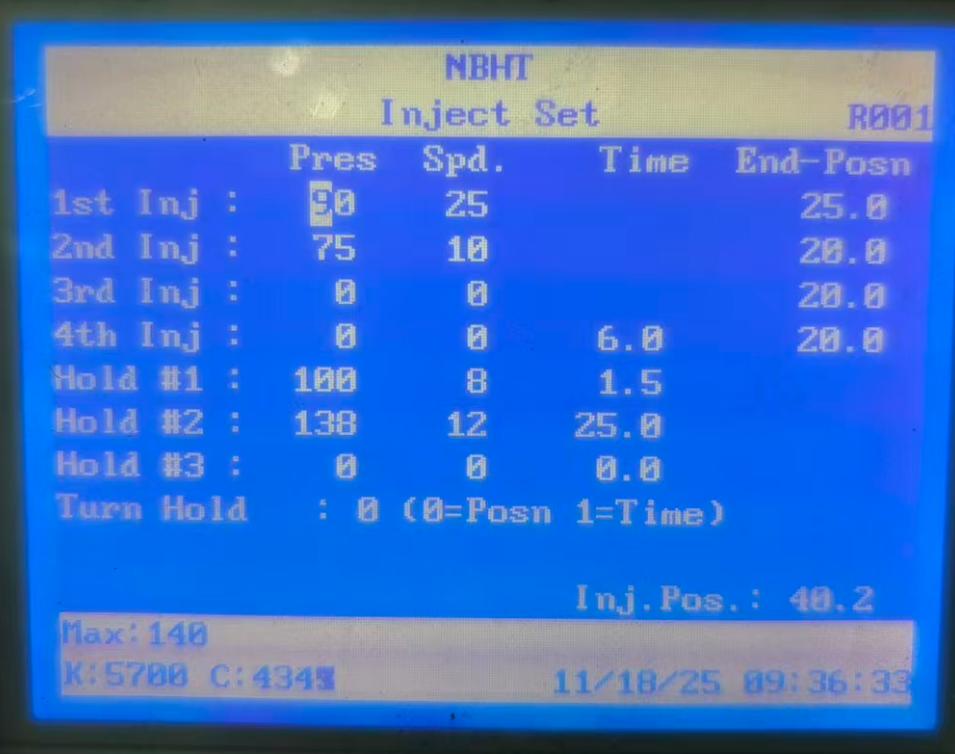
A good injection molding process window means the molding process can tolerate reasonable changes in temperature, pressure, material, and machine conditions while still producing acceptable parts.
This matters much more in mass production than during a single mold trial.
A supplier may produce ten good samples after spending several hours adjusting the machine. That proves the mold can make good parts under one specific condition. It does not prove the process is stable.
The real test is whether the mold can continue producing good parts when normal production conditions change slightly.
That is why buyers should care about the process window before approving a mold for production.
What Is an Injection Molding Process Window?
An injection molding process window is the range of molding conditions within which acceptable parts can be produced consistently.
These conditions normally include:
- Melt temperature
- Mold temperature
- Injection speed
- Injection pressure
- Holding pressure
- Holding time
- Cooling time
- Back pressure
- Screw speed
Suppose a part can only be molded correctly when the injection speed is exactly 68 mm/s and the holding pressure is very close to one specific setting.
A small change causes flash, short shots, sink marks, or dimensional problems.
That is a narrow process window.
Now consider another mold.
The same part remains acceptable across a reasonable range of injection speeds and holding pressures.
That process is much safer for production.
The second mold may not produce a visibly better T1 sample, but it is usually the better production mold.
Why a Narrow Process Window Causes Problems Later
During a mold trial, conditions are relatively controlled.
The machine is prepared, engineers are watching the process, and adjustments can be made immediately.
Mass production is different.
Conditions naturally change.
For example:
- Material batches change
- Ambient temperature changes
- Machine temperature fluctuates
- Cooling water temperature changes
- Operators change shifts
- Resin moisture changes slightly
- Check rings and screws wear over time
These variations are normal.
A stable molding process should tolerate reasonable changes without immediately producing defects.
If the injection molding process window is too narrow, small variations can suddenly create quality problems.
This is why a mold can pass T1 or T2 but still become troublesome after production starts.
Do Not Use Process Settings to Hide Mold Problems
This is one of the most important points when improving process stability.
Not every molding problem should be fixed by changing machine parameters.
Suppose a part has flash around a slider.
The first reaction may be to reduce injection pressure.
The flash disappears.
Problem solved?
Maybe not.
If the real cause is poor slider fitting or insufficient locking strength, reducing injection pressure has only hidden the mold problem.
Later, another material batch flows slightly differently and the flash returns.
The operator reduces pressure again.
Then the part develops a short shot.
Now the usable process window becomes extremely narrow.
This is a common way unstable processes are created.
A mold should have enough mechanical margin before process optimization begins.
Injection Molding Process Window Starts With Good Mold Design
A stable process cannot always be created at the injection machine.
Many problems begin much earlier.
Important mold design factors include:
- Gate location
- Gate size
- Runner balance
- Venting
- Cooling
- Mold strength
- Slider locking
- Parting line fitting
- Ejection
- Cavity balance
For example, if the gate is too small, the process may require high injection pressure to fill the part.
That leaves less room for adjustment.
If pressure is reduced slightly, the part may short shot.
If pressure is increased slightly, flash may appear.
The problem is not that the molding engineer cannot find the right setting.
The problem is that the acceptable range is too small.
This is why mold design directly affects the final injection molding process window.
Gate Design Has a Major Effect on Process Stability
Gate design is one area we pay particular attention to.
A gate that is too small can create excessive shear and high injection pressure.
A gate that freezes too early can also reduce the effective holding time.
As a result, part weight and dimensions become very sensitive to pressure changes.
Gate location matters as well.
Poor gate placement may cause:
- Hesitation
- Uneven filling
- Weld lines
- Air traps
- Uneven packing
- Warpage
- Large pressure loss
In these cases, adjusting injection speed may improve one defect while making another worse.
The better approach is to improve the filling condition so the mold does not depend on one very specific machine setting.
Venting Can Make the Process Window Much Wider
Poor venting is another common reason a process becomes difficult to control.
When air cannot escape from the cavity, the machine must push against trapped gas.
This may lead to:
- Short shots
- Burn marks
- High injection pressure
- Unstable filling
- Weld line problems
The operator may increase injection pressure to complete filling.
But higher pressure may create flash somewhere else.
Again, the injection molding process window becomes narrower.
Good venting allows the plastic to fill the cavity more easily and with less pressure.
In many cases, improving vents provides a more permanent solution than repeatedly changing injection parameters.
Cooling Must Be Stable Before the Process Can Be Stable
Cooling has a large effect on dimensions, shrinkage, warpage, and cycle time.
If one area of the mold is much hotter than another, the part may shrink unevenly.
Changing holding pressure may temporarily improve the dimension, but it does not fix the temperature imbalance.
This becomes especially important for:
- Large plastic housings
- Flat parts
- Thin-wall parts
- Precision components
- Parts with thick and thin sections
Cooling water temperature and flow should therefore be checked during mold trials.
A mold may produce good parts during a short trial while the steel is still relatively cool.
After several hundred shots, the mold reaches thermal balance and the dimensions begin to change.
For this reason, dimensions should be evaluated after the molding process has become thermally stable.
You can also see our guide on injection molding dimensional stability for factors that affect dimensions during long production runs.
Separate Filling, Packing and Cooling Problems
A common mistake during mold trials is adjusting too many parameters at the same time.
For example, a dimension is too small.
The operator changes:
- Injection speed
- Holding pressure
- Holding time
- Mold temperature
The next sample is better.
But which parameter actually solved the problem?
Nobody knows.
This makes future troubleshooting much more difficult.
A better approach is to separate the process into stages.
First confirm filling.
Then confirm packing.
Then evaluate cooling and dimensions.
This makes the relationship between machine settings and product quality much clearer.
We use the same principle when trying to reduce mold trial times. Random parameter changes often create more trials rather than fewer.
Injection Molding Process Window Should Not Be Based on One Good Sample
This sounds obvious, but it happens frequently.
A supplier sends several good-looking samples.
The dimensions pass.
The buyer approves the mold.
However, those samples may have been selected from a much larger batch.
For production approval, buyers should understand whether the process can repeat.
A useful trial should run long enough to observe:
- Filling consistency
- Part weight
- Dimensions
- Appearance
- Cycle time
- Mold temperature
- Ejection
- Machine pressure
Parts should be checked at different times during the run rather than only selecting the best pieces.
A good mold trial demonstrates repeatability, not just the ability to produce one acceptable shot. This is also an important part of injection mold acceptance.
Test the Upper and Lower Limits
One practical way to understand the process window is to move important settings slightly away from the standard condition.
For example, if the approved holding pressure is 70 MPa, engineers can evaluate how the part behaves at slightly lower and higher pressure.
The same can be done with:
- Injection speed
- Melt temperature
- Mold temperature
- Cooling time
The purpose is not to intentionally produce bad parts.
The purpose is to understand how much margin the process has.
If a small adjustment immediately produces a defect, the process may be too sensitive.
That deserves investigation before mass production.
Part Weight Is a Simple Stability Indicator
Part weight is useful during process development because it can reveal changes that may not be immediately visible.
If molding conditions are stable, part weight should normally remain within a relatively narrow range.
Large variation can indicate problems with:
- Filling
- Packing
- Material feeding
- Cushion
- Check ring performance
- Gate freeze
- Machine repeatability
For precision projects, part weight should be evaluated together with critical dimensions.
Weight alone cannot prove that a part is good, but it is a useful process indicator.
Dimensional Stability Must Be Verified Over Time
For parts with tight tolerances, measure samples from different stages of the production trial.
Do not only measure five parts produced immediately after the machine is adjusted.
For example, samples can be taken after:
- Process stabilization
- 30 minutes
- 60 minutes
- Several hundred cycles
This helps identify whether dimensions are drifting as the mold temperature changes.
It also helps reveal whether the cooling system can maintain stable conditions.
For projects where dimensional control is important, buyers should agree on measurement methods and tolerances before production. Our injection molding tolerances guide explains some of the main factors that influence molded-part dimensions.
Material Condition Must Be Controlled During Validation
A good injection molding process window cannot be established using uncontrolled material.
This is particularly important for hygroscopic materials such as:
- PA
- PC
- PBT
- PET
If resin moisture varies significantly between trials, the process results are difficult to compare.
Material drying conditions should therefore be recorded.
For some projects, material batch information should also be retained.
This becomes more important when dealing with:
- Glass-filled materials
- Flame-retardant grades
- High-temperature plastics
- Tight dimensional tolerances
A stable mold with unstable material can still create unstable production.
What Should Buyers Ask Their Supplier to Validate?
Buyers do not need to request a huge process validation report for every simple plastic part.
But for important projects, several questions are worth asking:
- Was the mold tested after reaching stable temperature?
- Was the cycle run continuously?
- Were dimensions checked at different points during the trial?
- Is part weight stable?
- How sensitive is the part to injection pressure?
- How sensitive is it to holding pressure?
- Is the filling pressure unusually high?
- Does a small setting change create flash or short shots?
- Are all cavities balanced?
- Is cooling stable?
- Are there any parameters being used mainly to compensate for a tooling problem?
These questions usually reveal much more than simply asking for the final machine setting sheet.
A Stable Process Does Not Mean Fixed Parameters Forever
There is no single perfect set of injection molding parameters that will remain unchanged forever.
Machines vary.
Material batches vary.
Environmental conditions vary.
The goal of developing a good injection molding process window is therefore not to create one untouchable parameter sheet.
The goal is to establish a reliable operating range.
Within that range, the process should continue producing acceptable parts even when normal production variation occurs.
That is what makes the process robust.
Final Thoughts
A wide injection molding process window gives production more margin.
A narrow window forces operators to constantly adjust settings and makes the process sensitive to material, temperature, machine, and environmental changes.
To improve process stability, start with the mold rather than the machine.
Check gate design, venting, cooling, mold strength, filling balance, and fitting first. Then establish the molding process systematically by separating filling, packing, and cooling.
Finally, validate the process over a continuous production run and check whether reasonable parameter changes can still produce acceptable parts.
A mold that only produces good parts at one very specific setting may pass a sample trial.
A good production mold should do more than that.
It should make good parts repeatedly without requiring someone to constantly stand beside the machine and adjust it.