
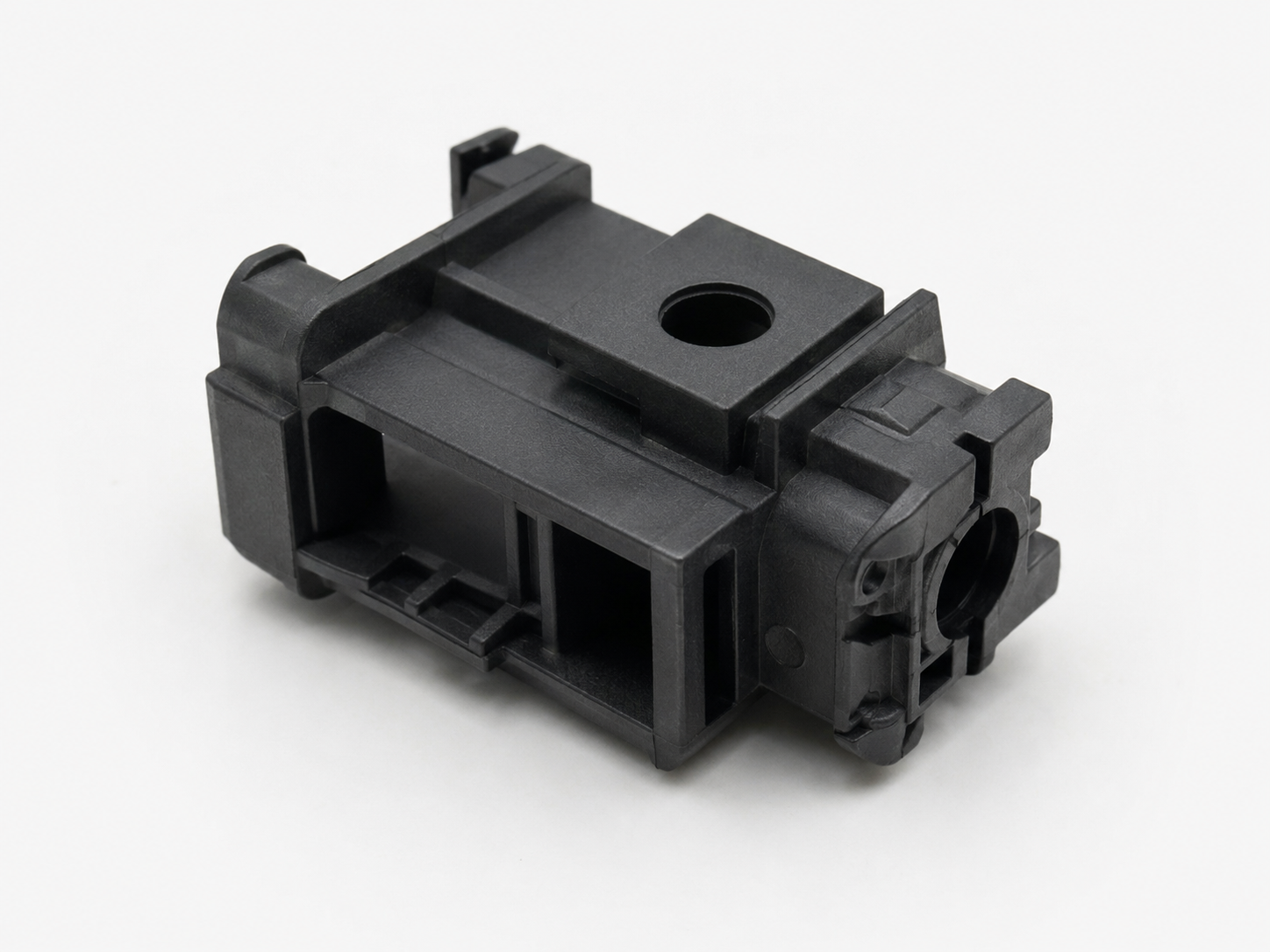
Choosing a small plastic parts manufacturer may look simple because the parts themselves are small. In reality, small molded components can be more demanding than much larger plastic parts.
A connector, clip, gear, sensor component, button, small housing, or precision insert may weigh only a few grams, but a small dimensional change can affect assembly, sealing, movement, or electrical connection.
When several cavities are used, the challenge becomes even greater. It is not enough to produce one good sample. Every cavity needs to remain reasonably consistent during long production runs.
For buyers, the important question is therefore not simply:
“Can this supplier mold small plastic parts?”
The better question is:
“Can this supplier produce them repeatedly, within the required dimensions and quality level?”
What Should a Small Plastic Parts Manufacturer Be Able to Control?
Small plastic parts usually leave less room for error.
A 0.10 mm variation may be insignificant on a large decorative housing but critical on a small connector or mating feature.
A capable supplier should understand how the mold, material, machine, and molding process work together.
The main areas to evaluate are:
- Critical dimensions
- Mold machining accuracy
- Cavity-to-cavity consistency
- Gate design
- Venting
- Ejection
- Material behavior
- Process stability
- Inspection
- Production repeatability
The supplier does not need to promise extremely tight tolerances on every dimension.
In fact, a supplier that accepts every tolerance without discussion can create more risk.
The important thing is knowing which dimensions matter and how they will be controlled.
Start With the Drawing, Not the Injection Molding Machine
Before quoting, a reliable small plastic parts manufacturer should review the part drawing and 3D model carefully.
For precision components, we normally pay particular attention to:
- Assembly dimensions
- Hole diameters
- Pin locations
- Snap-fit areas
- Sealing surfaces
- Wall thickness
- Ribs and bosses
- Draft angles
- Undercuts
- Flatness requirements
- Material
- Surface requirements
Not every dimension should receive the same level of control.
For example, a decorative outer edge may tolerate more variation than a hole that receives a shaft or a feature that connects with another component.
A reliable small plastic parts manufacturer should identify critical dimensions before tooling starts rather than waiting until T1 to discover tolerance problems.
This is why tolerance review should happen before mold manufacturing begins.
Our guide to injection molding tolerances explains how material shrinkage, geometry, mold design, and processing conditions can all affect the finished dimension.
If a supplier only looks at the overall size of the part and immediately gives a price, important risks may not be identified until T1.
Why Mold Accuracy Matters for a Small Plastic Parts Manufacturer
Small molded parts often require relatively small mold features.
A small error in an insert, shut-off, pin, slider, or cavity can represent a significant percentage of the final feature size.
This makes the tooling stage especially important.
For a precision small part, the mold manufacturer may need to control:
- Core and cavity dimensions
- Insert positioning
- Shut-off fitting
- Guide systems
- Ejector pin positions
- Slider movement
- Cavity alignment
- Gate dimensions
- Vent depth
At Fentormold, our injection mold manufacturing work starts with the actual part requirement rather than using the same tooling specification for every project.
A simple PP clip does not need the same mold construction as a small engineering component with several mating dimensions.
That difference affects both mold cost and production stability.
Multi-Cavity Capability for a Small Plastic Parts Manufacturer
Small plastic components are often suitable for multi-cavity molds.
A single cavity may be sufficient for lower volumes, but as annual demand increases, buyers commonly consider:
- 2 cavities
- 4 cavities
- 8 cavities
- 16 cavities
- Higher cavity counts
More cavities can reduce molding cost per part, but they also create another challenge:
Can every cavity produce the same result?
Imagine an eight-cavity mold.
Cavity 1 produces a diameter of 8.02 mm.
Cavity 2 produces 8.03 mm.
Cavity 3 produces 8.01 mm.
That may be acceptable.
But if cavity 7 consistently produces 8.10 mm, adjusting the machine may improve one cavity while making the others worse.
This is why cavity balance is important.
A capable small plastic parts manufacturer should consider:
- Runner balance
- Gate consistency
- Cavity machining
- Cooling balance
- Venting
- Material flow
- Cavity-to-cavity inspection
Our article comparing single cavity vs multi cavity molds explains how cavity count should be selected according to production volume, part size, tooling investment, and unit-cost targets.
Simply adding more cavities is not always the right solution.
How a Small Plastic Parts Manufacturer Controls Gate and Venting
On a small plastic component, there may be very little space available for the gate.
But the gate still has to provide enough material flow without creating unacceptable marks or excessive shear.
A poorly selected gate can lead to:
- Short shots
- Weld lines
- Flow marks
- Gate blush
- Excessive pressure
- Difficult gate removal
- Part deformation
Venting can be equally important.
Small features and thin sections can trap air quickly during filling. If the mold cannot release that air effectively, the result may be burning, incomplete filling, or unstable molding.
These issues may not look serious during a few initial samples.
During continuous production, however, a marginal molding condition can become much more obvious.
That is why the mold should not only be designed to make the part.
It should be designed to run the part repeatedly.
Ejection Must Be Stable Without Damaging the Part
Small plastic parts can be surprisingly difficult to eject.
Thin walls, small ribs, deep bosses, and tight core features can create strong holding forces.
If the ejector system is not well designed, possible problems include:
- Ejector marks
- Whitening
- Deformation
- Cracking
- Parts remaining on the core
- Bent ejector pins
- Inconsistent automatic production
For high-volume small parts, stable automatic ejection becomes particularly important.
A mold that requires an operator to manually remove stuck parts every few cycles may still produce acceptable samples, but it is not ready for efficient production.
For this reason, a small plastic parts manufacturer should evaluate ejection stability as part of production readiness, not only part appearance.
When evaluating a supplier, buyers should therefore ask not only whether the part passed inspection, but also how consistently the mold operated during the trial.
Material Experience Also Matters
Different materials behave very differently in small molded features.
ABS, PC, POM, PA, PP, TPE, and glass-filled engineering plastics do not have the same:
- Shrinkage
- Flow behavior
- Mold temperature requirements
- Moisture sensitivity
- Wear characteristics
- Dimensional stability
For example, a small POM mechanical part may require particular attention to shrinkage and dimensional stability.
A glass-filled nylon component introduces different concerns, including directional shrinkage and additional mold wear.
The exact material grade should therefore be confirmed as early as possible.
Changing from one resin grade to another after the mold has already been built can sometimes change the molded dimensions enough to require mold correction.
How a Small Plastic Parts Manufacturer Checks Part Quality
Inspection equipment matters, but inspection planning matters even more.
A supplier does not need to measure every possible dimension on every single part.
Instead, the inspection plan should concentrate on the features that affect function and assembly.
Depending on the project, inspection may include:
- Calipers
- Micrometers
- Height gauges
- Pin gauges
- Projectors
- CMM inspection
- Custom checking fixtures
For multi-cavity molds, it is also important to identify samples by cavity during mold trials.
Otherwise, a dimensional report showing ten mixed parts may hide a cavity-specific problem.
For example, if only cavity 4 produces an oversized feature, knowing the cavity number makes mold correction much more direct.
Without cavity identification, the team may spend unnecessary time adjusting the molding process rather than correcting the actual mold problem.
Do Not Judge Capability From One Perfect T1 Sample
This is an important point.
A supplier can sometimes adjust molding parameters until a few samples look excellent.
That does not automatically mean the process is stable.
For production, buyers should care about repeatability.
Ask questions such as:
- Are the dimensions stable after the process runs for several hours?
- Are different cavities consistent?
- Does the part deform after cooling?
- Is the mold running automatically?
- Are parts sticking?
- Is flash becoming worse as the mold heats up?
- Does the cycle time remain stable?
- Are critical dimensions drifting?
A reliable small plastic parts manufacturer should think beyond sample approval.
The goal is not one good shot.
The goal is hundreds or thousands of acceptable cycles.
Production Control at a Small Plastic Parts Manufacturer
Once the mold is approved, the job is not finished.
Long-term production can expose issues that were not obvious during a short mold trial.
Moving components wear.
Vents become dirty.
Ejector pins require maintenance.
Material batches can vary.
Processing conditions can drift.
For this reason, production should include basic controls for:
- Material handling
- Machine settings
- First-piece inspection
- In-process inspection
- Cavity identification where necessary
- Mold maintenance
- Defect handling
- Packaging
Our injection molding production capability allows the same project to continue from mold development into part production, which can make technical follow-up easier when dimensional or molding issues appear later.
This is particularly useful for small precision components because mold condition and molding conditions are closely connected.
Communication Is Part of Manufacturing Capability
A buyer may be thousands of kilometers away from the factory.
That makes communication part of the manufacturing process.
You should be able to ask:
“Why is this dimension out of tolerance?”
and receive a useful answer.
Not:
“We will improve it.”
But something more specific:
“The dimension is 0.08 mm oversize in cavities 3 and 4. We checked the steel dimensions and will correct the corresponding inserts before the next trial.”
A capable small plastic parts manufacturer should be able to explain dimensional or molding problems with specific data rather than general statements.
That type of communication tells you much more about a supplier than a polished company presentation.
A reliable supplier should be willing to show problems.
Injection molding projects rarely move from drawing to mass production without any adjustment.
The important thing is whether problems are identified clearly and corrected systematically.
How to Evaluate a Small Plastic Parts Manufacturer
When comparing a small plastic parts manufacturer, avoid making the decision from price alone.
A practical evaluation should answer these questions:
| Area | What to Check |
|---|---|
| Drawing review | Does the supplier identify critical dimensions and risks? |
| Tooling | Can the supplier control small inserts and mold features? |
| Tolerances | Are tolerance commitments realistic? |
| Multi-cavity molds | Can cavities be balanced and inspected individually? |
| Gate and venting | Are they designed around the actual material and geometry? |
| Ejection | Can the mold run reliably without damaging parts? |
| Material | Does the supplier understand the selected resin? |
| Inspection | Are critical dimensions measured correctly? |
| Production | Can quality remain stable beyond T1 samples? |
| Communication | Can technical problems be explained clearly? |
You do not necessarily need the largest factory.
You need a supplier whose equipment, engineering capability, quality control, and production approach match the actual requirements of your part.
Final Thoughts
A reliable small plastic parts manufacturer is not defined simply by the ability to operate an injection molding machine.
For small precision components, the real capability comes from controlling the complete process:
Drawing review → mold design → precision machining → mold trial → measurement → correction → stable production
The smaller the component becomes, the more important details such as cavity consistency, small mold features, gate design, venting, ejection, material behavior, and dimensional control can become.
When evaluating suppliers, do not ask only:
“Can you make this part?”
Ask:
“How will you keep this part consistent during production?”
That question usually tells you much more about the supplier you are considering.
If you have a small plastic component that requires tooling and production, you can send Fentormold the 3D file, 2D drawing, material, expected production quantity, and critical dimensions. We can review the project before tooling and identify the areas that need the most attention.