Injection mold ownership is easy to ignore when a project is moving smoothly. Buyers usually focus on mold price, lead time, T1 samples, dimensions, and production cost.
The problem often appears later.
You may want to move production to another factory. The supplier may stop responding. The mold may need major repair. Your project volume may increase. Or the original supplier may no longer be the right production partner.
Then a simple question suddenly becomes very important:
Who actually owns the mold?
Paying for tooling does not always mean every ownership detail has been clearly agreed. Before paying the mold balance, buyers should confirm what belongs to them, what documents they can receive, and whether the mold can be transferred without unnecessary disputes.
What Does Injection Mold Ownership Actually Include?
When buyers talk about injection mold ownership, they often mean the physical mold.
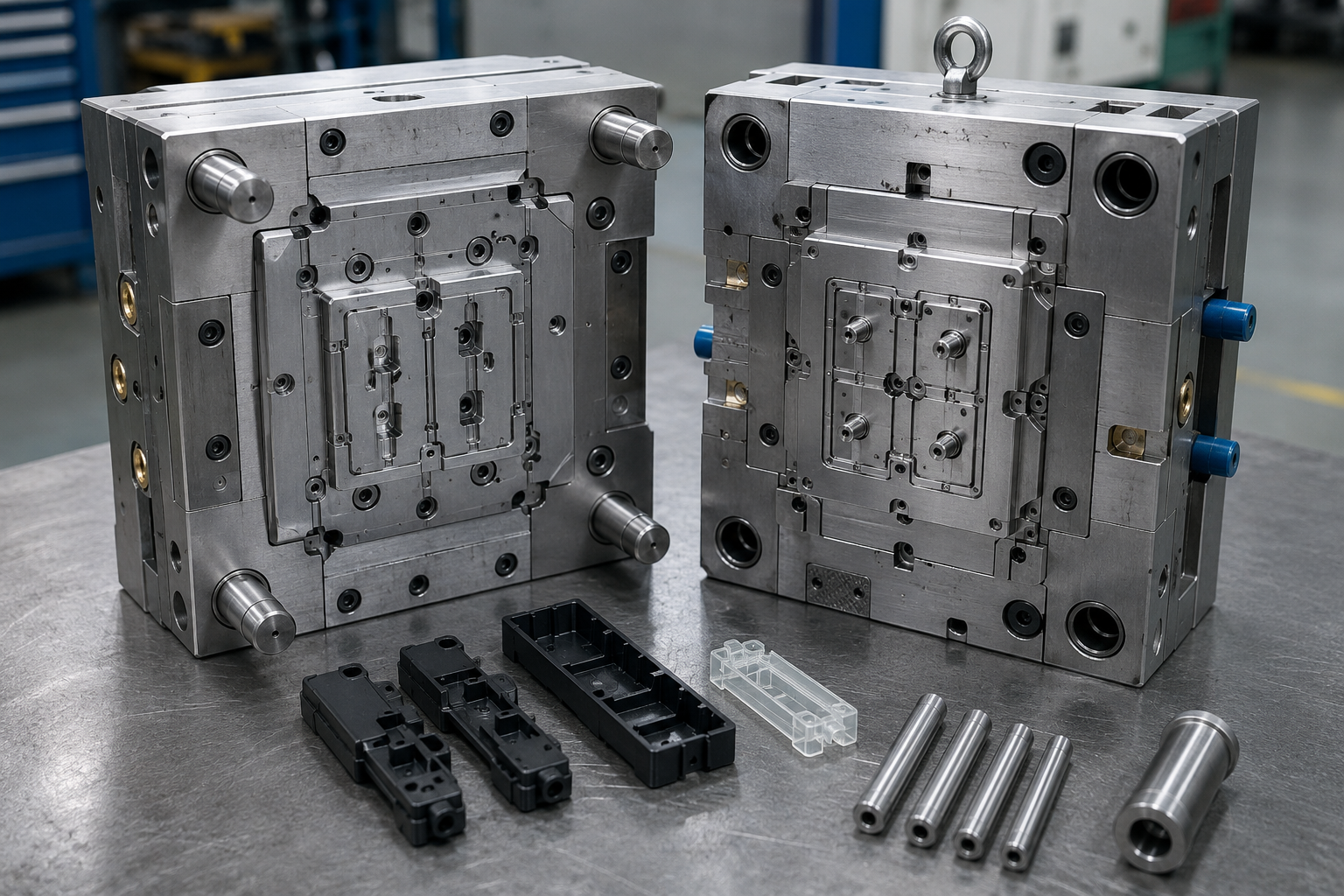
But a tooling project includes much more than two pieces of steel.
Depending on the project, ownership and access may involve:
- Mold base
- Core and cavity inserts
- Sliders and lifters
- Interchangeable inserts
- Spare components
- Hot runner system
- Electrodes
- Mold 3D files
- Mold 2D drawings
- Product files supplied by the buyer
- Mold-flow reports
- Inspection reports
- Trial records
- Modification history
This distinction matters.
A supplier may agree that the physical mold belongs to the customer but still treat mold drawings or certain manufacturing data as internal information.
If you expect to receive those files later, confirm this before placing the tooling order.
Our guide to injection mold documentation explains the main files buyers should normally discuss during a tooling project.
Confirm Injection Mold Ownership Before the Mold Is Built
The best time to discuss injection mold ownership is not when the relationship has already gone wrong.
It is before tooling begins.
The quotation, purchase order, or tooling agreement should clearly state whether the mold becomes the buyer’s property after full payment.
A simple statement can prevent a lot of confusion later.
For example, buyers should understand:
- When ownership transfers
- Whether ownership depends on full payment
- Whether any tooling components are excluded
- Whether the mold can be removed from the supplier’s factory
- Whether unpaid production invoices affect mold release
- Whether the supplier can use the tooling for another customer
Do not assume both sides understand these points in the same way.
Does Injection Mold Ownership Begin After Full Payment?
In many normal custom tooling projects, the buyer expects to own the mold after the agreed tooling price has been paid.
However, the commercial arrangement should still be confirmed in writing.
Some tooling quotations may include different structures.
For example:
- Buyer fully pays for a dedicated production mold
- Supplier partially subsidizes the mold
- Tooling cost is amortized into part price
- Mold is built only for production at that supplier
- Prototype tooling is treated differently from long-life production tooling
These arrangements are not necessarily wrong.
The problem is when the buyer and supplier have different expectations.
If a supplier offers a mold price significantly below other quotations, buyers should understand whether the price includes complete ownership or whether the supplier expects to recover part of the tooling cost through future production.
A clear commercial structure is better than a cheap quotation followed by an ownership dispute later.
Injection Mold Ownership Should Include Transfer Rights
One of the most important questions is:
Can you move the mold to another supplier?
A buyer may need to transfer tooling for many legitimate reasons:
- Production demand changes
- The supplier’s capacity becomes limited
- Quality becomes unstable
- Communication becomes difficult
- Local production is required
- A second production source is needed
- The project is being moved to another country
- The original supplier closes or changes business direction
If you own the mold, you should know what happens when you request its release.
Before paying the final tooling balance, confirm:
- The mold can be transferred after payment
- The supplier will prepare it for shipment
- Documentation will be supplied
- Water and electrical connections are identified
- Loose components are packed together
- Spare parts are included
- The latest mold drawings match the physical tool
This becomes particularly important if the project later needs another injection mold manufacturer to inspect, modify, or continue production.
Does Injection Mold Ownership Include CAD Files and Mold Drawings?
This area is often less clear than ownership of the physical mold.
The customer usually owns the original product files they supplied.
But mold design files may be treated differently depending on the agreement.
Before ordering, ask whether you will receive:
- Final mold 3D
- Mold assembly drawing
- 2D mold drawing
- Insert drawings
- Cooling layout
- Hot runner information
- Component specifications
Clear injection mold ownership should also define which technical files the buyer is entitled to receive after tooling is completed.
You may never need these files while the original supplier is producing the parts.
But if the mold needs to be transferred five years later, they can save considerable time.
Without a current mold 3D file, another factory may need to measure and reverse-engineer parts of the mold before major repairs can begin.
That adds both cost and uncertainty.
Check Whether Third-Party Components Are Included
Not every component inside a mold is manufactured by the mold supplier.
Typical purchased components include:
- Hot runner systems
- Hydraulic cylinders
- Standard mold components
- Springs
- Limit switches
- Connectors
- Date stamps
- Special sensors
Buyers should know whether these components are part of the tooling they purchased.
For most normal projects, installed components should remain with the mold.
However, hot runner controllers or other external equipment may sometimes be treated separately.
If the mold depends on specific external equipment, confirm exactly what will be supplied if the mold is transferred.
A mold arriving at another factory without the required controller, cables, connectors, or technical information can create an unnecessary delay.
What Happens to Spare Inserts and Electrodes?
This is a small detail that is often forgotten.
During mold manufacturing, the supplier may produce:
- Spare inserts
- Replacement ejector pins
- EDM electrodes
- Trial inserts
- Alternative gate inserts
- Spare wear plates
Some of these may have significant value later.
For example, if a small cavity insert is damaged after several years of production, an existing electrode may make repair easier.
Buyers do not necessarily need every machining aid used during mold manufacturing.
But for critical or difficult-to-reproduce components, it is worth discussing what should be stored with the mold.
How Injection Mold Ownership Affects Mold Storage
After production stops, where does the mold go?
Many suppliers store customer molds at no charge while production remains active.
But long-term storage policies can vary.
Confirm:
- How long the supplier will store the mold
- Whether storage is free
- Whether long-term storage fees apply
- How molds are protected against rust
- How often inactive molds are checked
- What happens if the buyer has no orders for several years
- Whether the supplier can dispose of inactive tooling
A mold can remain unused for years and still have considerable value.
The ownership agreement should prevent tooling from being discarded simply because no recent production order has been placed.
Maintenance Does Not Change Injection Mold Ownership
A supplier may spend substantial time maintaining a customer-owned mold.
That does not normally mean ownership has changed.
However, buyers should understand who pays for different types of work.
Normal production maintenance may include:
- Cleaning
- Lubrication
- Vent cleaning
- Minor fitting
- Ejector maintenance
- Rust prevention
Major repair may involve:
- Welding
- New inserts
- Slider replacement
- Hot runner repair
- Mold base repair
- Large dimensional corrections
These costs should be separated from the question of ownership.
At the same time, buyers should request records when major mold changes are made.
If several modifications occur over the life of the mold, the latest drawings should ideally be updated.
Otherwise, the physical mold and the original 3D model may eventually become different.
Injection Mold Ownership: What to Confirm Before Final Payment
Final tooling payment should not be based only on the fact that the mold has physically been completed.
Before paying the final balance, buyers should normally confirm the agreed acceptance requirements.
Depending on the project, this may include:
- T1/T2 samples approved
- Critical dimensions checked
- Appearance accepted
- Assembly confirmed
- Mold operates safely
- Ejection is stable
- Cooling system works correctly
- No serious leakage
- Sliders and lifters move correctly
- Automatic molding is possible where required
- Agreed documentation is complete
A mold trial is important because many issues cannot be judged from photographs alone.
For example, a mold may look completely finished but still have problems with venting, ejection, flash, cooling, or part deformation.
Our article on how to reduce mold trial times discusses why each trial should close specific technical issues rather than simply produce another set of samples.
Be Careful With the Phrase “Mold Is Finished”
Different people can mean different things when they say this.
For the mold manufacturer, “finished” may mean:
All machining and assembly work is complete.
For the buyer, “finished” may mean:
The mold produces acceptable parts repeatedly.
Those are not the same.
Before the final payment stage, define what mold acceptance actually means.
For a simple cosmetic part, approval may mainly depend on dimensions and appearance.
For a functional part, buyers may also need to confirm:
- Assembly
- Sealing
- Strength
- Flatness
- Movement
- Fit with other components
The tooling agreement should reflect the real requirements of the project.
Injection Mold Ownership and Production Are Separate Decisions
Owning a mold does not mean you should constantly move it between factories.
If the supplier is producing stable parts at a reasonable cost, keeping the mold in the same factory is usually the simplest solution.
The value of injection mold ownership is that the buyer keeps control of the asset if circumstances change.
For projects where tooling and molding are handled together, keeping mold development and injection molding production under the same engineering team can also make later adjustments easier.
If a dimensional issue appears during production, the team that understands the mold can inspect both tooling and process conditions rather than treating them as separate problems.
Ownership provides flexibility.
It does not mean mold transfer should be the first choice whenever a small problem occurs.
How to Define Injection Mold Ownership in the Purchase Order
The wording does not have to be complicated.
For many normal tooling projects, buyers should at least make sure the commercial documents answer these questions:
| Item | What to Confirm |
|---|---|
| Physical mold | Who owns it after full payment? |
| Mold transfer | Can the buyer remove the mold? |
| Product data | Does the buyer retain ownership? |
| Mold drawings | Which files will be supplied? |
| Purchased components | Are they included with the mold? |
| Spare parts | What will be stored or delivered? |
| Maintenance | Who pays for normal and major repairs? |
| Modifications | Will drawings be updated? |
| Storage | How long will the mold be retained? |
| Final payment | What acceptance conditions must be met? |
For larger or commercially sensitive projects, buyers may also want their own legal adviser to review the tooling agreement.
For normal manufacturing projects, however, even a clear purchase order can eliminate many misunderstandings.
Red Flags Buyers Should Not Ignore
Be cautious if a supplier avoids answering basic ownership questions.
For example:
“Why do you need the mold drawing?”
or:
“The mold cannot leave our factory.”
or:
“We will discuss ownership later.”
These answers do not automatically mean there is a problem, because different commercial models exist.
But they do mean the buyer needs more clarification before making payment.
A professional supplier should be able to explain the arrangement clearly.
If the mold is supplier-owned, say so.
If the customer owns it after full payment, say so.
If drawings are excluded, state that before the order.
Most disputes become serious because the expectations were never aligned at the beginning.
Final Thoughts
Injection mold ownership should be confirmed before tooling begins, not after the project has already developed problems.
Buyers should know exactly what they are paying for and what control they will have after the mold is completed.
Before final payment, confirm:
- Ownership of the physical mold
- Right to transfer the mold
- Access to agreed mold drawings
- Ownership of customer product files
- Included spare and purchased components
- Storage conditions
- Maintenance responsibilities
- Mold acceptance requirements
In practice, clear injection mold ownership gives buyers more control over future production, repair, transfer, and supplier changes.
Most buyers hope they will never need to move their mold.
That is usually a good outcome.
But if production requirements change several years later, clear injection mold ownership gives you options instead of starting a dispute at the worst possible time.
If you are starting a new tooling project, Fentormold can review the 3D files, drawings, material, production requirements, and tooling expectations before mold manufacturing begins so that the technical and commercial responsibilities are clear from the start.