
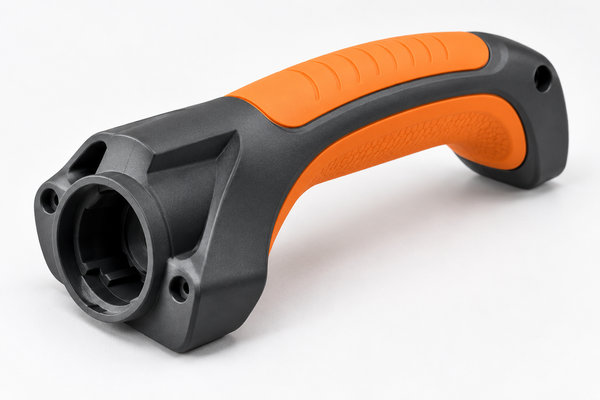
TPE injection molding is widely used for soft-touch grips, seals, flexible covers, automotive parts, consumer products and industrial components. Thermoplastic elastomers combine rubber-like flexibility with the processing advantages of thermoplastics.
However, TPE can be more sensitive than many rigid plastics. Shrinkage, warpage, flash, bubbles, poor surface quality and sticking can appear when material, mold design and processing conditions are not well controlled.
Therefore, stable TPE production requires more than simply setting the correct melt temperature.
At Fentor Mold, we review part geometry, material behavior and mold structure before production. This helps reduce common TPE molding problems during trials and mass production.
What Is TPE Injection Molding?
TPE injection molding uses thermoplastic elastomer pellets that melt when heated and solidify when cooled.
Unlike thermoset rubber, TPE can be melted and processed again.
Common TPE families include:
- TPE-S
- TPU
- TPO
- TPV
- TPE-E
- TPE-A
Each type behaves differently.
For example, TPU often provides high wear resistance and strength. TPV performs well in automotive sealing applications. Meanwhile, softer TPE-S materials are widely used for grips and overmolded consumer parts.
Therefore, molders should not treat all TPE materials as one single material group.
Why Is TPE Injection Molding More Difficult Than Rigid Plastic Molding?
Soft TPE materials can flow differently from ABS, PP, PC or nylon.
Depending on the grade, TPE may have:
- High elasticity
- Low hardness
- High shrinkage
- Strong mold adhesion
- High sensitivity to temperature
- Moisture sensitivity
- Easy deformation after ejection
As a result, a mold that works well for rigid plastic may not automatically work well for TPE.
Mold design and processing conditions should match the exact TPE grade.
TPE Injection Molding Shrinkage
Shrinkage is one of the most important issues in TPE injection molding.
After the material fills the cavity, it cools and contracts.
The final shrinkage depends on several factors:
- Material type
- Hardness
- Part thickness
- Mold temperature
- Melt temperature
- Packing pressure
- Cooling time
- Gate size
- Flow direction
Softer TPE grades may show greater dimensional movement than harder grades.
Therefore, engineers should use the material supplier’s shrinkage data as a starting point. Trial results should then confirm the real value.
How to Control Shrinkage in TPE Injection Molding
Shrinkage cannot be completely eliminated, but it can be controlled.
Use Stable Processing Conditions
Changing temperature or pressure from cycle to cycle causes inconsistent shrinkage.
Therefore, the molding machine should maintain stable:
- Melt temperature
- Mold temperature
- Injection speed
- Holding pressure
- Holding time
- Cooling time
A stable process usually produces more stable dimensions.
Optimize Packing Pressure
If holding pressure is too low, the material may shrink excessively after filling.
However, excessive pressure can create other problems such as flash or internal stress.
Therefore, packing pressure should be high enough to compensate for shrinkage but not so high that it creates new defects.
Keep Wall Thickness Consistent
Large thickness changes can create uneven cooling.
Thick sections cool more slowly than thin sections.
As a result, they may shrink more.
Whenever possible, keep the wall thickness uniform.
If a thick area is necessary, gradual transitions can reduce sudden changes.
TPE Injection Molding and Warpage
Warpage happens when different areas of the part shrink at different rates.
Common causes include:
- Uneven wall thickness
- Uneven cooling
- Poor gate location
- High residual stress
- Incorrect ejection
- Asymmetric geometry
Flexible TPE parts may look acceptable immediately after molding but change shape after cooling.
Therefore, dimensional checks should not always be performed immediately after ejection.
Allowing the part to stabilize can give a more realistic result.
How Gate Design Affects TPE Shrinkage
Gate location strongly affects filling and shrinkage.
A poorly positioned gate can cause:
- Uneven flow
- Uneven packing
- Weld lines
- Air traps
- Dimensional variation
- Warpage
For large or complex TPE parts, gate position should support balanced filling.
The gate should also remain open long enough for packing pressure to work.
If the gate freezes too early, additional pressure cannot compensate for shrinkage.
For production projects, early injection molding production review can help identify gate, cooling and process risks before production begins.
Common TPE Injection Molding Defects
Several defects appear frequently in TPE production.
The most common include:
- Flash
- Short shots
- Sink marks
- Bubbles
- Burn marks
- Flow lines
- Weld lines
- Sticking
- Surface marks
- Warpage
Each defect usually has more than one possible cause.
Therefore, process adjustment should be based on the actual defect rather than changing several parameters at the same time.
TPE Injection Molding Flash
Flash occurs when material escapes between mold surfaces.
TPE can be especially sensitive to flash because many soft grades flow easily.
Common causes include:
- Too much injection pressure
- Excessive melt temperature
- Poor mold shut-off
- Worn parting surfaces
- Insufficient clamping force
- Poor vent design
The first step is to determine whether the problem comes from the process or the mold.
If the mold has damaged shut-off surfaces, reducing pressure may only hide the real problem.
Short Shots in TPE Injection Molding
A short shot occurs when the cavity does not fill completely.
Possible causes include:
- Low melt temperature
- Low injection pressure
- Slow filling
- Small gate size
- Poor venting
- Long flow length
- Premature freezing
Increasing temperature may help, but it should not be the first solution every time.
Instead, review the complete flow path.
A larger gate or better venting may solve the problem more effectively.
Sink Marks and TPE Shrinkage
Sink marks usually appear in thicker sections.
They often form near:
- Ribs
- Bosses
- Thick corners
- Heavy wall transitions
When thick areas cool, the inside continues shrinking after the outside surface has already solidified.
This can pull the surface inward.
To reduce sink marks:
- Reduce thick sections
- Use better packing
- Improve gate location
- Extend holding time
- Improve cooling
- Redesign ribs and bosses
The best solution is often a combination of part design and process control.
Bubbles and Voids in TPE Parts
Bubbles can appear inside or on the surface of TPE parts.
Possible causes include:
- Moisture
- Trapped air
- Excessive melt temperature
- Poor venting
- Material degradation
Moisture-sensitive TPE grades should be dried correctly before molding.
However, drying temperature and time depend on the exact material.
Therefore, always follow the resin supplier’s recommendations.
Over-drying some materials can also create problems.
Burn Marks in TPE Injection Molding
Burn marks often appear near the end of fill.
They may result from compressed trapped air.
As material enters the cavity quickly, air can become trapped and heated.
This may create dark marks.
Possible solutions include:
- Improve venting
- Reduce injection speed near end of fill
- Change gate position
- Reduce excessive temperature
Burn marks should not be treated only as a cosmetic problem.
They can indicate poor air evacuation inside the mold.
TPE Surface Flow Lines
Flow lines may appear as visible patterns on the molded surface.
Common causes include:
- Low melt temperature
- Low mold temperature
- Slow injection speed
- Sudden wall thickness changes
- Poor gate location
Cosmetic TPE parts require especially careful flow control.
For visible parts, gate position should be chosen early during mold design.
Weld Lines in TPE Parts
Weld lines form where two flow fronts meet.
They may appear around:
- Holes
- Inserts
- Core pins
- Complex geometry
In some parts, the weld line may only affect appearance.
However, in other cases it can reduce strength.
Possible improvements include:
- Change gate position
- Increase material temperature
- Increase mold temperature
- Improve venting
- Increase flow speed
Again, the best solution depends on geometry.
TPE Injection Molding and Mold Sticking
Soft materials can stick to mold surfaces.
This can cause:
- Part deformation
- Drag marks
- Tearing
- Long cycle times
- Ejection damage
Possible causes include:
- Insufficient draft
- Rough mold surfaces
- Deep textures
- Excessive undercuts
- High material adhesion
- Poor ejection design
Therefore, draft angle is especially important for soft TPE parts.
Draft Angle for TPE Parts
Rigid plastic parts may release easily with relatively small draft angles.
Soft TPE can behave differently.
Because the material is flexible, it may stretch during ejection.
However, this does not mean draft can be ignored.
Deep textures and soft materials often require more draft.
A better draft angle can reduce:
- Drag marks
- Part distortion
- Mold sticking
- Ejection force
This should be reviewed during DFM.
Mold Surface Finish for TPE Injection Molding
The mold surface directly affects the final TPE surface.
Depending on the product, the mold may use:
- Polished finish
- Fine texture
- Matte texture
- EDM texture
- Chemical texture
However, deep texture can make demolding more difficult.
Therefore, texture depth and draft angle should be considered together.
For soft-touch parts, appearance and release performance must both be controlled.
Venting in TPE Injection Molding
Good venting is critical.
Poor venting can cause:
- Short shots
- Burn marks
- Weld lines
- Surface defects
- Excessive injection pressure
Because TPE may flash easily, vent depth must also be controlled carefully.
If vents are too deep, material may escape.
If they are too shallow, air cannot leave.
Therefore, venting requires a balance between air release and flash prevention.
TPE Injection Molding Temperature Control
Temperature strongly affects TPE flow.
If melt temperature is too low:
- Flow may be poor
- Short shots may appear
- Weld lines may worsen
If temperature is too high:
- Flash may increase
- Material may degrade
- Cycle time may increase
- Surface defects may appear
The correct temperature depends on the exact TPE family and grade.
Therefore, process settings should start from the material supplier’s technical data rather than using one standard temperature for all TPE materials.
Mold Temperature and TPE Part Quality
Mold temperature affects:
- Surface finish
- Filling
- Shrinkage
- Cycle time
- Dimensional stability
Higher mold temperatures can sometimes improve flow and appearance.
However, they may increase cycle time.
Lower mold temperatures may shorten cooling but create poor filling or surface problems.
The best setting depends on both material and geometry.
Drying TPE Before Injection Molding
Not every TPE grade requires the same drying process.
Some grades absorb more moisture than others.
Moisture can cause:
- Bubbles
- Splay
- Poor surface quality
- Material degradation
Therefore, storage conditions also matter.
Open material bags should be protected from humid air.
For moisture-sensitive materials, drying should happen shortly before production.
TPE Injection Molding Cooling Time
Cooling time affects both productivity and part stability.
If the part is ejected too early, it may deform.
This is especially common with:
- Soft parts
- Thick sections
- Large flat parts
- Weak structures
However, excessive cooling increases cycle time and cost.
Therefore, cooling should be long enough to keep the part stable but not unnecessarily long.
Balanced mold cooling can help reduce both warpage and cycle time.
TPE Injection Molding Ejection Design
Ejection should spread force across the part.
Small ejector pins can leave deep marks on soft TPE.
Possible solutions include:
- Larger ejector areas
- More ejector pins
- Stripper plates
- Air ejection
- Optimized release geometry
The correct approach depends on the shape of the part.
If appearance is important, ejector locations should also avoid cosmetic surfaces.
TPE Injection Molding for Overmolding
TPE is frequently used for overmolding rigid plastic substrates.
Common combinations include TPE with selected grades of:
- PP
- ABS
- PC
- PC/ABS
- Nylon
However, bonding performance depends on the exact TPE formulation and substrate.
Therefore, engineers should verify chemical compatibility before tooling.
Mechanical locks can also improve retention.
If you are developing a soft-touch or multi-material component, our TPE Overmolding Guide explains bonding, material compatibility and tooling considerations in more detail.
Two-Shot Molding vs TPE Overmolding
Some TPE parts are produced by insert overmolding, while others use a two-shot process.
Insert overmolding usually molds the rigid substrate first. The part is then transferred into another mold for TPE molding.
Two-shot molding integrates both materials in one production system.
The choice depends on:
- Production volume
- Tooling budget
- Part geometry
- Automation requirements
- Bonding requirements
- Cycle time
For a deeper comparison, see our article on Two-Shot Molding vs Overmolding.
How to Reduce TPE Injection Molding Defects
A stable TPE process usually starts with several basic controls.
Control the Material
Use the correct grade.
Store it properly.
Dry it when required.
Avoid contamination.
Control the Mold
Check:
- Gate size
- Venting
- Cooling
- Shut-off
- Draft
- Ejection
- Surface condition
Control the Process
Monitor:
- Melt temperature
- Mold temperature
- Injection speed
- Packing pressure
- Holding time
- Cooling time
Changing only one variable at a time makes troubleshooting easier.
DFM Before TPE Injection Molding
Many TPE defects can be prevented before the mold is built.
A DFM review should check:
- Wall thickness
- Thick sections
- Gate position
- Draft angle
- Texture
- Undercuts
- Ejection
- Parting line
- Venting
- Cooling
- Critical dimensions
At Fentor Mold, we review these areas before tooling begins. Our prototype injection molding service can also help validate TPE behavior, shrinkage and dimensional performance before larger-scale production.
Final Thoughts
TPE injection molding requires careful control because soft thermoplastic elastomers respond strongly to temperature, pressure, mold design and cooling conditions.
Shrinkage should be considered during both part design and mold design.
Meanwhile, defects such as flash, bubbles, short shots, sticking and warpage often indicate a combination of material, tooling and process issues.
Therefore, stable production depends on controlling the complete system rather than adjusting one parameter alone.
By reviewing material selection, part geometry, mold design and processing conditions early, manufacturers can reduce defects, improve dimensional stability and achieve more consistent TPE parts.