
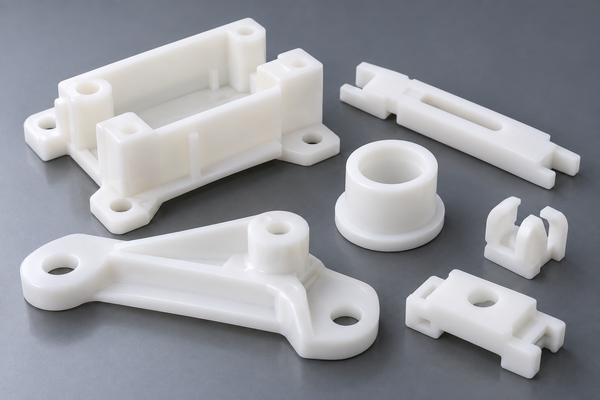
Delrin injection molding is widely used for gears, bushings, clips, automotive parts, precision mechanisms and industrial components. Delrin, which belongs to the POM family, offers low friction, good wear resistance and strong dimensional performance.
However, accurate molded parts still require careful process control.
Shrinkage, cooling, wall thickness, gate position and packing pressure can all change the final size. In addition, some parts continue to move slightly after ejection.
Therefore, dimensional stability should be considered during part design, mold design and production setup.
At Fentor Mold, we review shrinkage, critical dimensions, gate design and cooling before production. As a result, many dimensional problems can be reduced before the mold enters mass production.
What Is Delrin Injection Molding?
Delrin injection molding uses acetal resin, also known as POM, to produce strong and accurate plastic parts.
Delrin is commonly linked with POM homopolymer. However, the wider POM family also includes copolymer grades.
Both types offer:
- High stiffness
- Low friction
- Good wear resistance
- Good fatigue resistance
- Good dimensional stability
Therefore, Delrin and other POM materials are common in moving and precision components.
Typical applications include:
- Gears
- Bearings
- Bushings
- Clips
- Snap-fit parts
- Automotive components
- Valve parts
- Electrical components
- Mechanical assemblies
Because POM is semi-crystalline, shrinkage must be controlled carefully.
Why Dimensional Stability Matters in Delrin Injection Molding
Dimensional stability means that the part keeps the required size and shape after molding.
This is especially important for precision components.
For example, a small dimensional change may affect:
- Gear engagement
- Bearing fits
- Snap-fit strength
- Shaft alignment
- Sliding movement
- Sealing
- Assembly
A part may look correct after ejection. However, its size can still change as it cools.
Therefore, critical dimensions should be checked after the part has stabilized.
Delrin Injection Molding Shrinkage
Shrinkage is one of the main factors in Delrin injection molding.
POM contracts as it cools and crystallizes. Therefore, the cavity must include the correct shrinkage allowance.
Actual shrinkage depends on:
- Material grade
- Wall thickness
- Mold temperature
- Melt temperature
- Packing pressure
- Holding time
- Gate size
- Cooling rate
- Flow direction
As a result, one fixed shrinkage value cannot suit every part.
Material supplier data is a good starting point. However, final dimensions should be confirmed through mold trials.
How Wall Thickness Affects Delrin Injection Molding
Wall thickness has a direct effect on shrinkage and cooling.
Thick sections cool more slowly. Therefore, they often shrink more than thin areas.
Large wall changes may cause:
- Sink marks
- Warpage
- Internal stress
- Dimensional variation
For better stability, keep the wall thickness as even as possible.
If thickness must change, use a gradual transition. This helps the part cool more evenly.
Avoid Heavy Solid Sections
Very thick sections can create more problems than benefits.
For example, they may:
- Increase cycle time
- Increase shrinkage
- Create sink marks
- Reduce dimensional control
Instead, ribs can often improve stiffness with less material.
However, rib thickness should also be controlled. If a rib is too thick, local sink marks may appear.
Delrin Injection Molding Gate Position
Gate location affects filling, packing and final shrinkage.
A poor gate position may cause one area to pack better than another.
As a result, the part may show:
- Uneven shrinkage
- Warpage
- Dimensional variation
- Weld lines
- Internal stress
Therefore, the gate should support balanced filling.
Flow direction also matters because POM can shrink differently along and across the flow direction.
For production projects, early injection molding production review can help identify these risks before mass production.
Gate Size and Holding Pressure in Delrin Injection Molding
A very small gate may freeze too early.
Once the gate freezes, packing pressure can no longer add material into the cavity.
Therefore, shrinkage may increase.
A larger gate can sometimes keep the gate open longer. However, gate size must also consider:
- Gate mark
- Cycle time
- Automatic degating
- Part appearance
- Part geometry
Therefore, the goal is not simply to make the gate larger. The gate should match the part and process.
Packing Pressure
Packing pressure helps compensate for shrinkage.
If pressure is too low, the part may become smaller or show sink marks.
However, excessive packing can also cause:
- Flash
- High internal stress
- Difficult ejection
- Over-packed areas
Therefore, stable packing is more important than maximum pressure.
Holding Time in Delrin Injection Molding
Holding time works together with packing pressure.
If holding time ends too early, the part may shrink more.
However, once the gate is fully frozen, extra holding time gives little benefit.
Therefore, the actual gate freeze time should be checked during mold trials.
This approach improves dimensional stability and avoids unnecessary cycle time.
Mold Temperature in Delrin Injection Molding
Mold temperature affects crystallization and shrinkage.
A stable mold temperature usually gives more stable part dimensions.
However, the mold may behave differently during the first few cycles.
For example, early parts may come from a relatively cool mold. Later, the steel reaches thermal balance.
As a result, dimensions may shift during the run.
Therefore, final inspection should use parts molded after the process becomes stable.
Delrin Injection Molding and Uneven Cooling
Uneven cooling is a major cause of warpage.
One side of the part may cool faster than the other.
As a result, each side shrinks at a different rate.
Common causes include:
- Uneven cooling channels
- Thick and thin wall transitions
- Hot spots
- Poor water flow
- Asymmetric geometry
- Poor gate position
Therefore, balanced cooling is critical for Delrin injection molding.
Our article on how to prevent injection molding warpage after cooling explains this issue in more detail.
Cooling Time and Delrin Part Stability
Cooling time also affects the final shape.
If the part is ejected too early, it may still be too warm.
As a result, ejector force can bend or distort it.
This is especially common with:
- Thin walls
- Long parts
- Flat parts
- Precision gears
- Weak sections
Longer cooling can improve stability. However, too much cooling increases cycle time.
Therefore, the goal is stable ejection without unnecessary delay.
Delrin Injection Molding Cooling Channel Design
Cooling channels should follow the part shape as closely as practical.
Poor cooling can create hot spots.
These areas may shrink more than nearby regions.
Therefore, engineers should review:
- Cooling channel location
- Channel diameter
- Water flow
- Core cooling
- Cavity cooling
- Insert cooling
In addition, cooling performance should remain stable during long runs.
Blocked or dirty water lines can slowly change mold temperature.
As a result, part dimensions may also change.
You can read more in our guide to injection mold cooling channels.
Delrin Injection Molding and Warpage
Warpage occurs when different areas shrink by different amounts.
The part may bend, twist or lose flatness.
Typical causes include:
- Uneven wall thickness
- Unbalanced filling
- Uneven cooling
- Poor gate location
- High residual stress
- Early ejection
However, the correct solution depends on the actual cause.
For example, higher packing pressure will not fix warpage caused by poor cooling.
Therefore, troubleshooting should separate mold, material and process factors.
Part Design for Better Delrin Injection Molding Stability
Good part design can reduce many dimensional problems before tooling begins.
Keep Wall Thickness Uniform
Uniform walls improve filling and cooling.
Therefore, they usually improve dimensional consistency.
Add Radii
Sharp corners increase stress.
A suitable radius can improve material flow and reduce stress concentration.
Reduce Large Solid Areas
Heavy sections cool slowly and may shrink more.
Therefore, hollow sections or ribs are often better.
Use Ribs Carefully
Ribs can improve stiffness.
However, they should not be too thick.
Support Large Flat Areas
Large flat surfaces may warp.
Therefore, ribs or structural features can improve stiffness.
Draft Angle in Delrin Injection Molding
Delrin has low friction, which helps mold release.
However, draft angle is still important.
Too little draft can increase ejection force.
As a result, the part may show:
- Ejector marks
- Scratches
- Deformation
- Stress
Textured surfaces usually need more draft.
Therefore, draft should be reviewed during DFM.
Ejection and Delrin Dimensional Stability
Ejection design is another important factor.
If force is concentrated in one small area, the part can bend while still warm.
This is especially risky for long and thin parts.
Therefore, ejector force should be spread across the part.
Common options include:
- Multiple ejector pins
- Larger ejector surfaces
- Sleeves
- Stripper plates
The best solution depends on part geometry.
Mold Accuracy in Delrin Injection Molding
Process adjustment cannot fully correct an inaccurate mold.
Critical mold areas include:
- Core size
- Cavity size
- Insert position
- Slider position
- Mold alignment
- Shut-off surfaces
For precision parts, even a small mold error can affect final size.
Therefore, machining accuracy is also important.
Fentor Mold’s components manufacturing capabilities support precision inserts and mold components where dimensional control is important.
Process Stability in Delrin Injection Molding
A stable process is necessary for repeatable dimensions.
Important parameters include:
- Melt temperature
- Mold temperature
- Injection speed
- V/P transfer position
- Packing pressure
- Holding time
- Cooling time
If one parameter changes too much, the dimensions may also change.
Therefore, the process should run within a controlled window.
Our article on the injection molding process window explains why stable conditions are important during production.
Melt Temperature and Delrin Injection Molding
Delrin should stay within the resin supplier’s recommended temperature range.
Excessive heat can degrade POM.
Therefore, avoid unnecessary overheating and long residence times.
Important factors include:
- Barrel temperature
- Residence time
- Screw speed
- Back pressure
Stable melt conditions usually improve repeatability.
Does Delrin Need Drying?
POM absorbs much less moisture than materials such as nylon.
Therefore, it usually has lower drying demands.
However, storage still matters.
Contamination or poor storage conditions can create molding problems.
If the material supplier recommends drying, follow that guidance.
Do not automatically apply nylon drying conditions to Delrin.
Regrind and Delrin Injection Molding
Regrind can affect process consistency.
Important variables include:
- Regrind percentage
- Contamination
- Thermal history
- Particle size
- Mixing consistency
For precision parts, these changes may affect shrinkage and mechanical performance.
Therefore, regrind should follow a controlled production specification.
Measure Delrin Parts at the Right Time
Measurement timing is important.
A Delrin part may continue to change slightly after ejection.
Therefore, critical projects should define:
- Measurement time
- Measurement temperature
- Inspection method
- Datum system
- Inspection equipment
For example, measuring one part immediately and another several hours later may produce inconsistent results.
A standard inspection method helps avoid this problem.
GD&T for Precision Delrin Injection Molding
GD&T can control function more effectively than very tight ± tolerances everywhere.
Useful controls include:
- Flatness
- Position
- Parallelism
- Perpendicularity
- Profile
- Concentricity
For example, a bore may have the correct diameter but still fail if its position is wrong.
Therefore, dimensional control should match the actual function.
Our article on high precision injection molding explains how mold accuracy, shrinkage and inspection work together.
Avoid Over-Tolerancing Delrin Parts
Very tight tolerances on every dimension can increase cost without improving function.
They may increase:
- Mold adjustment time
- Inspection cost
- Production difficulty
- Scrap risk
Instead, focus tighter control on critical areas.
| Dimension Type | Recommended Approach |
|---|---|
| Critical assembly dimensions | Tight control |
| Gear or bearing fits | Tight control |
| Sealing surfaces | Tight control |
| Cosmetic areas | Normal tolerance |
| Non-functional dimensions | Standard tolerance |
| Reference dimensions | Avoid unnecessary control |
Therefore, the goal is not the smallest tolerance possible.
The goal is the correct tolerance for the function.
Prototype Validation for Delrin Injection Molding
Trial production can help confirm actual shrinkage and dimensional behavior.
This is useful when:
- Dimensions are critical
- Wall thickness varies
- Geometry is complex
- Warpage risk is high
- A new POM grade is used
For early-stage validation, our prototype injection molding service can help confirm shrinkage and dimensional performance before larger production volumes.
How to Improve Delrin Injection Molding Dimensional Stability
Stable dimensions require control across the full process.
Control Part Design
Focus on:
- Wall thickness
- Ribs
- Sharp corners
- Flat areas
- Draft
Control Mold Design
Review:
- Shrinkage allowance
- Gate position
- Cooling
- Ejection
- Mold accuracy
Control the Process
Monitor:
- Melt temperature
- Mold temperature
- Packing pressure
- Holding time
- Cooling time
Control Inspection
Standardize:
- Measurement time
- Part temperature
- Critical dimensions
- GD&T
- Sampling frequency
As a result, Delrin injection molding becomes much more stable and repeatable.
Final Thoughts
Delrin injection molding is a strong choice for precision mechanical parts because POM offers good stiffness, low friction and wear resistance.
However, stable dimensions still depend on good engineering.
First, shrinkage must be considered during mold design. Next, wall thickness and gate position should support balanced filling and cooling. In addition, mold temperature, packing pressure and cooling time must remain stable.
Finally, inspection should use a consistent method.
By controlling part design, mold design, process conditions and measurement together, manufacturers can achieve more stable Delrin parts with less adjustment and lower rejection risk.