
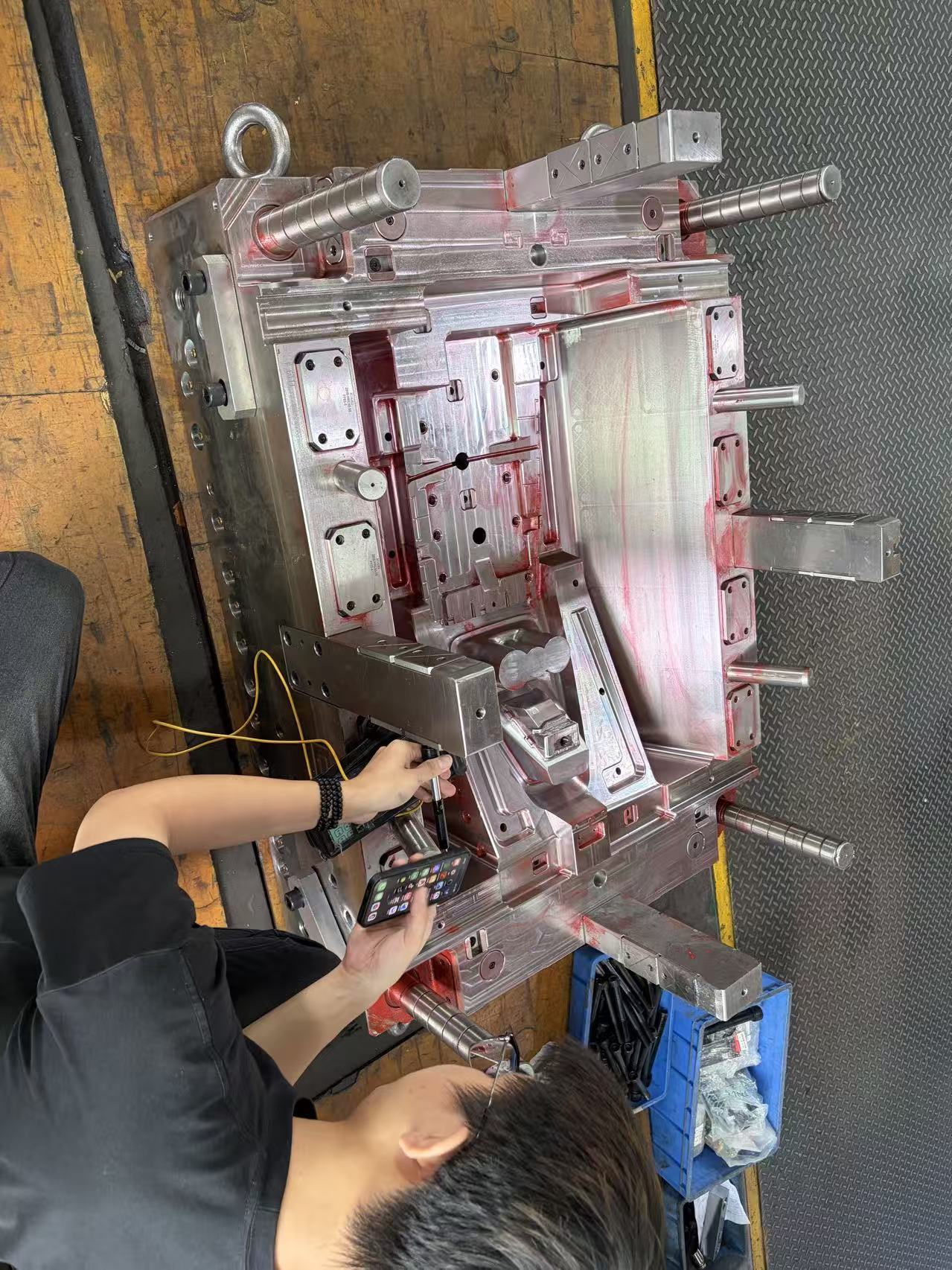
Mold steel hardness has a direct effect on wear resistance, dimensional stability, and injection mold life. Selecting the correct steel grade is important. However, checking whether the steel has reached the required hardness is just as important.
A drawing may specify H13 at HRC 48–52 or another hardened tool steel at a defined hardness range. However, the steel grade alone does not prove that the final mold component meets that requirement.
Heat treatment, machining, grinding, EDM, and even local surface conditions can affect the finished component.
Therefore, hardness testing should form part of mold quality control.
At Fentor Mold, we consider steel grade, heat treatment, component function, plastic material, and expected mold life together. This approach helps avoid choosing hardness based on one number alone.
What Is Mold Steel Hardness?
Mold steel hardness describes how strongly the steel resists indentation, scratching, and local surface deformation.
For injection molds, hardness matters because cavity surfaces and moving components face repeated mechanical contact.
Typical examples include:
- Core inserts
- Cavity inserts
- Sliders
- Lifters
- Shut-off areas
- Gate inserts
- Wear plates
- Ejector-related components
During production, these parts may experience pressure, friction, heat, and repeated movement.
Therefore, insufficient hardness can cause premature wear.
However, harder does not always mean better.
Steel that becomes too hard may lose toughness. As a result, thin inserts, sharp corners, or highly loaded components may become more sensitive to cracking.
The goal is to achieve the correct mold steel hardness for the actual application.
Why Does Mold Steel Hardness Matter for Mold Life?
A production mold may run thousands or hundreds of thousands of cycles. During every cycle, its surfaces experience mechanical and thermal stress.
For this reason, mold life depends partly on how well the steel resists these repeated loads.
Correct mold steel hardness can help improve:
- Wear resistance
- Surface durability
- Edge stability
- Dimensional consistency
- Resistance to plastic abrasion
- Service life of moving components
For example, abrasive engineering plastics can accelerate wear around gates, cavity surfaces, cores, and shut-offs.
Glass-filled materials are especially demanding.
In these applications, selecting the steel grade is only the first step. The finished hardness must also match the mold specification.
You can read more about steel selection in our guide to 1.2343, 738H, P20 and H13 mold steel properties.
How Is Mold Steel Hardness Tested?
Several methods can measure material hardness. However, Rockwell testing is one of the most common methods for hardened mold steel.
Rockwell HRC Hardness Testing
HRC refers to the Rockwell C hardness scale.
A hardness tester presses an indenter into the steel under a controlled load. The machine then calculates hardness from the indentation depth.
The result may look like:
HRC 48
or:
HRC 48–52
This method is fast and practical for many mold components.
Therefore, it works well for checking hardened:
- Cavity inserts
- Core inserts
- Sliders
- Lifters
- Gate inserts
- Wear-resistant components
However, the test surface needs enough size and suitable surface condition for a reliable measurement.
Portable Hardness Testing
Large mold plates or assembled tooling can be difficult to place on a standard hardness tester.
In that case, portable hardness equipment may provide a practical inspection method.
It can help engineers check:
- Large inserts
- Mold plates
- Finished molds
- Components that cannot easily be removed
However, measurement conditions still matter. Surface finish, component thickness, curvature, and tester calibration can influence the result.
Therefore, critical measurements should follow a defined inspection method.
Typical Mold Steel Hardness Levels
There is no single correct hardness for every mold.
Different steel grades, heat treatments, and mold applications require different ranges.
A simplified comparison looks like this:
| Mold Steel | Typical Condition | General Hardness Level | Common Application |
|---|---|---|---|
| P20 | Pre-hardened | Around HRC 28–34 | General injection molds |
| 738H | Pre-hardened | Around HRC 33–37 | Production molds and larger cavities |
| NAK80 | Pre-hardened | Around HRC 37–43 | Cosmetic and precision molds |
| S136 | Hardened | Often around HRC 48–52 | Polished and corrosion-resistant molds |
| H13 / 1.2344 | Hardened | Often around HRC 46–52 | High-wear and demanding inserts |
| 1.2343 | Hardened | Often around HRC 46–52 | Durable cores and cavities |
These values are general reference ranges rather than universal specifications.
The correct mold steel hardness depends on several factors, including production quantity, resin type, component geometry, required toughness, and steel supplier recommendations.
Therefore, the project specification should always take priority.
What Happens If Mold Steel Hardness Is Too Low?
Low hardness may not cause immediate mold failure.
In fact, a new mold can produce good T1 samples even when a critical component does not have enough hardness.
The problem often appears later.
Faster Surface Wear
Soft steel wears more quickly under repeated friction.
This becomes especially important around:
- Gates
- Shut-off surfaces
- Sliding areas
- Thin core features
- Textured cavity surfaces
As wear increases, dimensions may slowly change.
Flash Can Develop Over Time
Parting surfaces and shut-off areas need stable geometry.
If these surfaces wear too quickly, small gaps can develop.
As a result, plastic may enter the gap and create flash.
The mold may then require welding, machining, or insert replacement.
Dimensions May Become Unstable
Wear on a core or cavity changes the molded geometry.
Even a small amount of wear can matter for precision components.
Therefore, insufficient mold steel hardness can eventually cause dimensional variation during long production runs.
Maintenance Frequency Can Increase
A soft insert may need polishing, repair, or replacement more often.
Although lower hardness may make machining easier at the beginning, frequent maintenance can increase the total tooling cost.
Can Mold Steel Hardness Be Too High?
Yes.
This is why simply requesting the highest possible HRC is not good mold engineering.
High hardness usually improves wear resistance. However, it can also reduce toughness.
If a component becomes too brittle, it may crack under impact or stress.
This risk is higher for:
- Thin cores
- Sharp corners
- Deep ribs
- Small inserts
- Complex lifters
- Components under impact loading
Therefore, engineers need to balance hardness and toughness.
A slider, for example, needs good wear resistance. However, it also experiences mechanical movement and impact.
Meanwhile, a small cavity insert may require high surface durability but must still survive local stress.
The best hardness range depends on the component rather than the mold as a whole.
How Plastic Material Affects Mold Steel Hardness Requirements
The molded resin can strongly influence steel selection and wear requirements.
Standard Materials Such as PP and ABS
General-purpose plastics normally create less abrasive wear.
Therefore, pre-hardened steels such as P20 or 738H may provide enough performance for many standard production molds.
Production volume still matters, however.
A very high-volume mold may justify a higher-performance steel even when the resin itself is not highly abrasive.
Glass-Filled Engineering Plastics
Materials such as:
- PA66 GF30
- PA6 GF30
- PBT GF30
- PC GF
- PPS GF
contain glass fibers that can increase abrasive wear.
Therefore, critical cavity surfaces and gate areas may require better wear resistance.
Higher mold steel hardness, suitable tool steel, or surface treatment may become necessary.
Corrosive Plastics
Some materials or additives can also create corrosion concerns.
In these cases, corrosion resistance may be just as important as hardness.
Therefore, steel selection should consider the full operating environment rather than HRC alone.
Which Mold Components Should Have Hardness Checked?
Not every steel plate needs the same level of inspection.
Instead, priority should go to components where hardness directly affects performance or mold life.
Core and Cavity Inserts
These parts form the product geometry.
Therefore, wear can directly affect:
- Part dimensions
- Surface quality
- Flash
- Fit
- Assembly
For hardened inserts, checking final hardness provides useful evidence that heat treatment reached the required range.
Sliders and Lifters
Sliders and lifters move during almost every molding cycle.
Because of this movement, their contact surfaces face repeated friction.
Correct material, hardness, lubrication, and fitting clearance all contribute to long-term reliability.
Shut-Off Areas
Shut-offs often work under high contact pressure.
If they wear, flash may appear.
Therefore, both hardness and spotting quality matter.
Gate Inserts
Gate areas see concentrated resin flow.
With abrasive materials, wear can become more severe around the gate.
For this reason, some molds use replaceable hardened gate inserts.
Small High-Wear Inserts
Using a hardened replaceable insert in a local wear area can sometimes be more practical than hardening a much larger mold component.
This approach also makes future maintenance easier.
For more information, see our guide on choosing steel for injection mold inserts.
When Should Mold Steel Hardness Testing Be Done?
Hardness testing should happen at the correct manufacturing stage.
After Heat Treatment
This is one of the most important inspection points.
Once heat treatment is complete, engineers can confirm whether the component reached the specified hardness range.
If the result is wrong, the problem can be addressed before final assembly.
After Final Machining When Required
Some projects also require final verification after grinding, EDM, polishing, or other finishing operations.
This provides a record for the finished mold component.
Before Mold Shipment
For export molds, buyers may request final hardness records together with other tooling documents.
These may include:
- Steel certificate
- Hardness report
- Heat treatment report
- Dimension inspection report
- Mold trial report
- Mold drawings
A steel certificate proves the material grade, while a hardness report verifies the condition of the finished steel.
These are related checks, but they are not the same.
Our article about the injection mold steel certificate explains this difference in more detail.
Steel Grade and Hardness Must Be Checked Together
Checking only the HRC value is not enough.
For example, two different steel grades may both reach a similar hardness. However, they can still have very different:
- Toughness
- Corrosion resistance
- Thermal fatigue resistance
- Polishability
- Machinability
- Wear behavior
Therefore, mold quality control should answer two separate questions:
1. Is this the correct steel grade?
2. Has it reached the correct hardness?
Both matter.
This is particularly important for long-life molds, precision molds, high-value tooling, and molds processing abrasive engineering plastics.
Mold Steel Hardness Is Only One Part of Mold Life
Correct mold steel hardness can improve durability, but it cannot compensate for poor mold design.
Mold life also depends on:
- Steel quality
- Heat treatment
- Mold structure
- Machining accuracy
- Cooling
- Slider and lifter design
- Lubrication
- Mold maintenance
- Injection pressure
- Plastic material
- Production conditions
For example, a very hard slider can still fail if its guiding system is poor.
Likewise, a hardened cavity insert may still crack if sharp corners create excessive stress.
Therefore, hardness should form part of a complete tooling strategy.
At Fentor Mold, our injection mold manufacturing process considers steel selection, component design, machining, heat treatment, assembly, trial, and inspection together.
How Mold Steel Hardness Helps Reduce Long-Term Tooling Cost
The cheapest mold is not always the mold with the lowest initial tooling price.
For production tooling, unexpected repair creates indirect costs.
These may include:
- Machine downtime
- Replacement inserts
- Mold repair
- Production delays
- Extra setup time
- Part quality problems
Therefore, using the correct steel and verifying its hardness can help reduce long-term risk.
However, this does not mean every mold needs premium hardened steel.
A prototype mold or low-volume tool may have very different requirements from a mold expected to produce hundreds of thousands of parts.
The steel and hardness should match the real production target.
If you want to understand this relationship in more detail, see our guide on how to extend injection mold life and reduce maintenance costs.
Conclusion
Mold steel hardness is an important part of injection mold quality control.
The correct hardness helps resist wear, maintain dimensions, protect shut-off surfaces, and support longer mold life. However, hardness should never be evaluated alone.
Steel grade, toughness, plastic material, heat treatment, mold structure, production volume, and component function all need to work together.
Most importantly, a material certificate and a hardness test answer different questions. The certificate confirms the steel grade, while hardness testing helps confirm whether the finished component reached its required condition.
For long-life or demanding injection molds, checking both provides much stronger quality control before production begins.