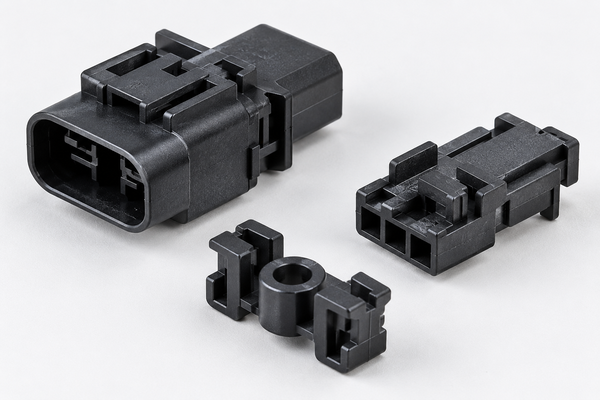
UL 94 V-0 injection molding is common for electrical housings, connectors, battery parts, and industrial products that need flame-retardant plastics.
However, selecting a resin marked “V-0” is not enough.
The exact resin grade, tested thickness, color, additives, recycled content, and molding process can all affect compliance risk.
Therefore, buyers should confirm these points before mold production starts.
At Fentor Mold, we normally review the resin grade, wall thickness, molding temperature, part design, and document needs before producing flame-retardant plastic parts.
What Does UL 94 V-0 Mean?
UL 94 is a standard used to test the flammability of plastic materials.
For vertical burning tests, common ratings include:
- V-0
- V-1
- V-2
Among these ratings, V-0 has stricter flame performance.
However, one key point is often missed.
The rating applies to a specific material under specific test conditions.
Therefore, not every version of the same plastic automatically has the same V-0 rating.
For example, two PC+ABS grades may both look similar. Still, only one may have the required V-0 rating at the needed wall thickness.
Why UL 94 V-0 Injection Molding Creates Purchasing Risks
The biggest risk in UL 94 V-0 injection molding is using a material that sounds correct but does not match the approved specification.
For example, a drawing may only say:
PC+ABS, UL94 V-0
That is too broad.
Many PC+ABS grades exist.
Some grades may reach V-0 at one thickness. Others may need a thicker test sample.
In addition, color and additives may affect the approved condition.
Therefore, the material specification should include the exact manufacturer and resin grade when certification matters.
Check the UL Yellow Card Before Material Approval
One of the best ways to reduce risk is to check the material’s UL Yellow Card.
The Yellow Card can help confirm:
- Material manufacturer
- Resin grade
- Flammability rating
- Recognized thickness
- Other tested properties
- Recognition status
Therefore, buyers should not rely only on a general material datasheet.
Instead, the approved material information should be checked before production.
This is especially important for electrical and safety-related parts.
UL 94 V-0 Injection Molding Depends on Part Thickness
Thickness is one of the most important points in UL 94 V-0 injection molding.
A resin may achieve V-0 at one thickness but not at a thinner one.
For example, a material may reach V-0 at 1.5 mm. However, the rating may change at a thinner section.
Therefore, writing only “UL94 V-0” on the drawing is not enough.
The designer should compare the minimum part thickness with the recognized material thickness.
This check should happen before mold design is finalized.
Why Thin Walls Can Increase Certification Risk
Modern plastic parts often use thin walls.
This can reduce:
- Weight
- Material use
- Cooling time
- Product size
However, thinner walls may change the flame rating.
For example, a resin may look suitable based on the datasheet. Later, the team may find that V-0 only applies above a certain thickness.
As a result, the part design may need to change.
Therefore, flame rating and wall thickness should always be reviewed together.
Material Grade Matters More Than the Polymer Name
“ABS,” “PC,” “PBT,” or “PA66” does not tell you whether a resin is V-0.
The exact grade matters.
Common V-0 material families may include special grades of:
- PC
- PC+ABS
- PBT
- PA66
- PPA
- PPS
- PEI
- PPSU
However, the polymer family alone does not prove the rating.
For example:
PC does not automatically mean V-0.
Likewise:
PA66 GF30 does not automatically mean V-0.
Therefore, buyers should specify the full resin grade.
Color Can Matter in UL 94 V-0 Injection Molding
Color is another point that buyers may overlook.
Pigments and color systems can change the final material formulation.
Therefore, a natural resin and a black resin should not always be treated as identical.
Before production, confirm:
- Approved resin grade
- Approved color
- Color masterbatch requirements
- Whether extra colorant is allowed
If certification is important, avoid changing the color system without review.
Be Careful With Masterbatch and Additives
Adding masterbatch may seem simple.
However, it changes the final material mix.
Common additions include:
- Color masterbatch
- UV additives
- Lubricants
- Processing aids
- Antistatic additives
- Fillers
If these were not part of the approved material system, they may create compliance risk.
Therefore, the safest approach is to use the approved resin and approved color system.
Do not change additives only to solve a short-term molding problem.
Recycled Material Can Create Extra Risk
Regrind or recycled resin can reduce waste.
However, it needs careful control in UL 94 V-0 injection molding.
Repeated heat history may affect:
- Strength
- Color
- Flow
- Flame performance
- Surface quality
In addition, some projects may limit the amount of regrind that can be used.
Therefore, uncontrolled recycled material should not be added only because the molded part still looks acceptable.
If certification matters, the regrind policy should be clear before production.
UL 94 V-0 Injection Molding and Material Substitution
Material substitution is another common risk.
A factory may face:
- Material shortages
- Long lead times
- Price increases
- Discontinued grades
As a result, purchasing may want to switch to a similar resin.
However, similar mechanical properties do not mean the same certification status.
For example, Brand A PC V-0 and Brand B PC V-0 may not have the same approved thickness or color condition.
Therefore, any material change should be reviewed before production.
Does V-0 Mean the Finished Product Is UL Certified?
No.
This is one of the most important points for buyers.
A resin with a UL 94 V-0 rating has been tested for flame behavior under defined conditions.
However, that does not mean the complete molded product is automatically UL certified.
The final product may also have its own:
- Construction rules
- Wall thickness rules
- Electrical requirements
- Component requirements
- End-product tests
Therefore, buyers should confirm what the final product standard requires.
Material recognition and finished-product certification are not the same thing.
Mold Design Still Matters for Flame-Retardant Materials
Even with the correct resin, mold design still matters.
Flame-retardant engineering plastics may have:
- Higher melt temperatures
- Lower flow
- Glass fiber
- More corrosive additives
- Higher shear sensitivity
Therefore, the mold should be designed for the actual resin.
Important areas include:
- Gate size
- Gate location
- Venting
- Cooling
- Runner design
- Mold steel
- Parting line design
Fentor Mold provides custom injection mold manufacturing with material and molding needs considered during mold development.
Gate Size in UL 94 V-0 Injection Molding
A gate that is too small can create too much shear.
As a result, the material may overheat.
This can cause:
- Burn marks
- Material damage
- High injection pressure
- Poor filling
Therefore, increasing machine pressure is not always the right answer.
In some cases, a larger gate or shorter flow path is better.
Venting Is Especially Important
Poor venting can trap air inside the cavity.
When the air is compressed, its temperature rises.
As a result, defects may include:
- Burn marks
- Black spots
- Short shots
- Surface damage
The risk may become higher with some flame-retardant resins.
Therefore, venting should be planned during mold design.
Do not wait until repeated mold trials reveal the problem.
Processing Temperature Must Stay Under Control
A higher melt temperature can improve flow.
However, too much heat may damage the resin.
This may lead to:
- Discoloration
- Black spots
- Gas
- Weak material
- Unstable molding
Therefore, barrel temperature should follow the resin supplier’s process guide.
Also, long residence time should be avoided.
This is especially important when the machine shot size is much larger than the molded part.
Drying Can Affect UL 94 V-0 Injection Molding Quality
Many engineering plastics need drying before molding.
Examples include:
- PC
- PC+ABS
- PA66
- PBT
- PPA
- PEI
Poor drying can cause:
- Silver streaks
- Bubbles
- Surface defects
- Material damage
- Lower strength
Therefore, drying conditions should follow the supplier’s datasheet.
In addition, dried material should stay protected from moisture before molding.
Glass-Filled V-0 Materials Need More Mold Protection
Many flame-retardant engineering plastics also contain glass fiber.
Examples include:
- PA66 GF30 FR
- PBT GF30 FR
- PPA GF30 FR
- PPS GF40
Glass fiber can improve stiffness.
However, it can also increase mold wear.
High-wear areas often include:
- Gate inserts
- Runner areas
- Cavity edges
- Core pins
- Shut-off surfaces
Therefore, mold steel and heat treatment should match the resin.
For more detail, see our article on improving wear resistance for PPS injection molds.
High-Temperature Materials Can Increase Tooling Risk
Many V-0 engineering resins also run at higher temperatures than common plastics.
As a result, the mold needs better control of:
- Temperature
- Steel selection
- Venting
- Gate design
- Cooling
- Machine stability
For difficult materials, the first mold trial may reveal problems that were not clear during design.
Our article on high-temperature injection molding T1 failure explains this in more detail.
Common UL 94 V-0 Injection Molding Risks
| Risk | Possible Result |
|---|---|
| Wrong material grade | Certification mismatch |
| Wrong wall thickness | V-0 rating may not apply |
| Unapproved color | Compliance risk |
| Uncontrolled masterbatch | Material recognition risk |
| Too much regrind | Unstable performance |
| Unauthorized substitution | Document mismatch |
| Poor drying | Surface and strength problems |
| Excessive melt temperature | Material damage |
| Small gate | High shear and burn marks |
| Poor venting | Burns and trapped gas |
| Glass-filled resin | Higher mold wear |
Therefore, material control and molding control must work together.
What Should Be Written on the Drawing?
If UL 94 V-0 is required, avoid a vague material note.
Instead of writing only:
Material: PC, UL94 V-0
a better specification may include:
- Resin manufacturer
- Exact grade
- Required UL 94 rating
- Required thickness
- Color
- Approved alternatives
- Regrind restriction
- Special document needs
This makes purchasing and production clearer.
In addition, it reduces the chance of an unauthorized material change.
What Documents Should Buyers Request?
Depending on the project, buyers may request:
- Material datasheet
- UL Yellow Card information
- Material certificate
- Resin lot information
- Certificate of Analysis
- Production inspection report
However, not every project needs the same documents.
Therefore, the document list should be confirmed before quotation.
This can prevent delays later.
How to Reduce UL 94 V-0 Certification Risks
For UL 94 V-0 injection molding, the following steps can reduce risk:
- Confirm the exact resin grade.
- Check the UL Yellow Card.
- Confirm the approved thickness.
- Confirm the approved color.
- Control masterbatch and additives.
- Define regrind rules.
- Prevent unapproved material changes.
- Use the correct drying conditions.
- Design gates and vents for the resin.
- Keep material records during production.
These steps are simple.
However, missing one can create expensive problems later.
What Buyers Should Confirm Before Tooling
Before mold production begins, confirm:
| Item | Why It Matters |
|---|---|
| Exact resin grade | Prevents material mismatch |
| V-0 requirement | Defines flame rating target |
| Minimum wall thickness | Must match approved conditions |
| Color | May affect recognition |
| Glass fiber content | Affects flow and mold wear |
| Production volume | Affects mold steel choice |
| Surface requirement | Affects gate and texture |
| Critical dimensions | Affects shrinkage control |
| Certification documents | Prevents late approval problems |
| Regrind policy | Controls material consistency |
Once these points are clear, mold design becomes more reliable.
Fentor Mold also provides injection molding production. Therefore, material control, tooling, and molding settings can be reviewed together.
Final Thoughts on UL 94 V-0 Injection Molding
Successful UL 94 V-0 injection molding starts with the correct material specification.
A V-0 label alone is not enough.
Buyers should confirm the exact resin grade, approved thickness, color, additives, and document needs.
At the same time, the mold must match the resin.
Gate size, venting, drying, mold steel, melt temperature, and process control all affect the final part.
Therefore, the safest approach is to review these requirements before tooling starts.
This can reduce material risk, avoid unnecessary mold changes, and make mass production easier to control.