
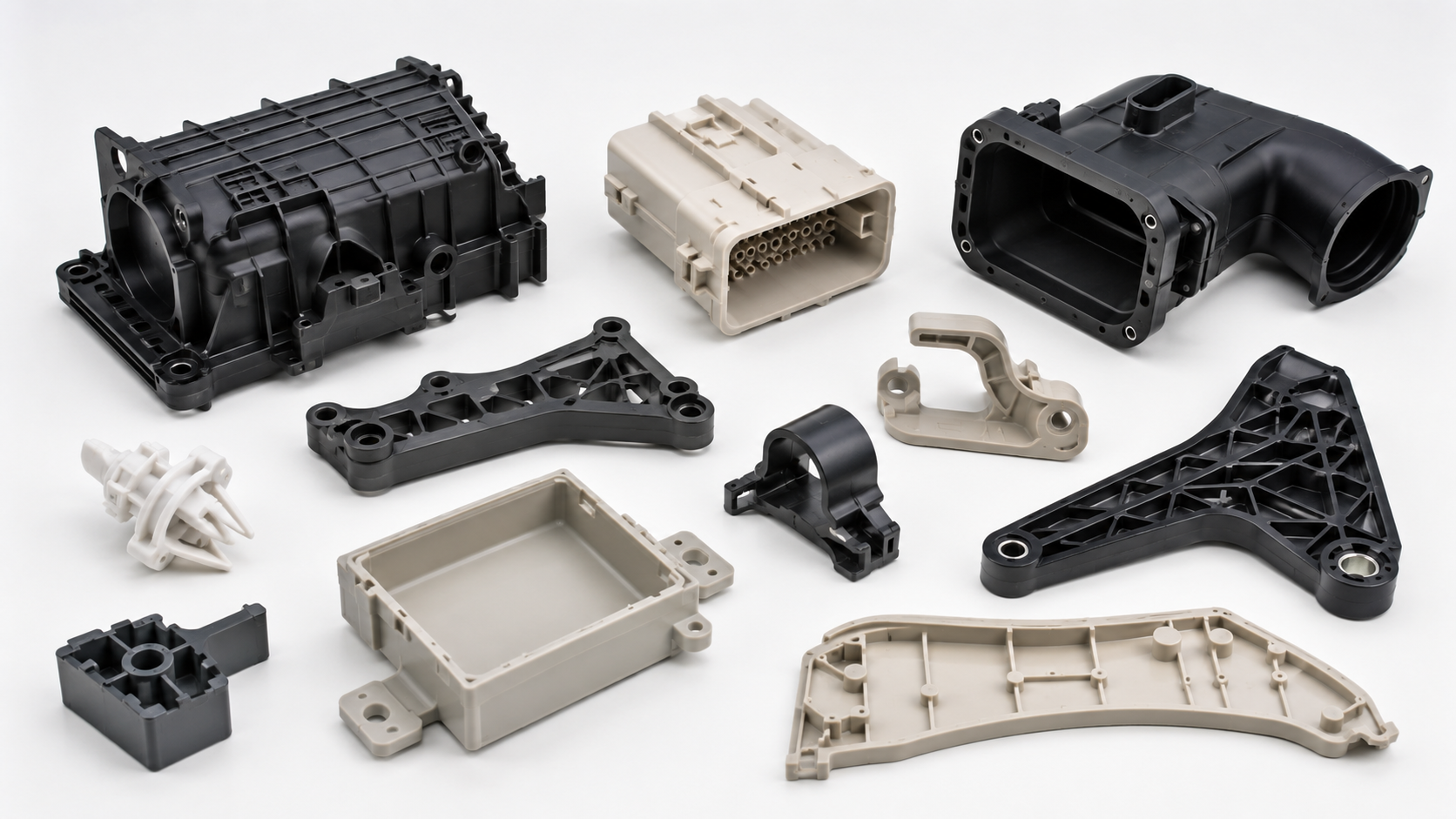
Aerospace plastic injection molding requires much tighter control than ordinary plastic part production because material performance, dimensional accuracy, traceability, and long-term consistency can directly affect assembly and product reliability.
A typical aerospace project may start with a relatively simple-looking plastic housing, connector, bracket, cover, or internal component. However, once the drawing is reviewed, the real challenges become clear.
The part may require:
- tight positional tolerances
- high-temperature resistance
- low weight
- flame resistance
- dimensional stability
- controlled material batches
- strict cosmetic standards
- repeatable long-term production
In addition, aerospace buyers often need more documentation and process control than general industrial customers.
Therefore, a successful project depends on much more than simply building an injection mold. Material selection, mold design, process stability, inspection, and supplier management all need to work together.
This guide explains what engineering and procurement teams should consider when sourcing aerospace plastic components.
What Is Aerospace Plastic Injection Molding?
Aerospace plastic injection molding is the production of plastic components for aircraft, aerospace equipment, electronics, control systems, interiors, and related assemblies using injection molding processes.
Typical molded parts may include:
- electronic housings
- electrical connectors
- protective covers
- cable management parts
- sensor housings
- brackets
- clips
- interior components
- insulation components
- ventilation parts
- precision mounting features
Compared with general-purpose molded parts, aerospace components often require more attention to material properties and dimensional stability.
For example, a simple commercial housing may mainly need acceptable appearance and fit.
An aerospace housing may also need:
- flame performance
- temperature stability
- chemical resistance
- low moisture absorption
- material certification
- dimensional inspection
- production traceability
As a result, the engineering requirements should be reviewed before tooling begins.
1. Material Selection Comes First
The plastic resin is one of the most important decisions in aerospace plastic injection molding.
A material should not be selected only because it is strong.
Instead, engineers should also consider:
- operating temperature
- mechanical load
- chemical exposure
- flame resistance
- moisture absorption
- dimensional stability
- weight
- electrical properties
- UV exposure
- long-term aging
Different aerospace applications require very different material performance.
Common Plastics Used for Aerospace Components
| Material | Main Advantages | Typical Considerations |
|---|---|---|
| PEEK | High temperature resistance, strength, chemical resistance | Expensive, requires high processing temperature |
| PEI / Ultem | Heat resistance, flame performance, dimensional stability | Requires controlled molding conditions |
| PPS | Good chemical and heat resistance | Mold wear may increase with glass-filled grades |
| PC | Impact strength, transparency options | Stress and moisture control are important |
| PA / Nylon | Good mechanical strength | Moisture absorption can affect dimensions |
| POM | Good dimensional stability and low friction | Not suitable for every high-temperature application |
| ABS | Good appearance and processability | Limited high-temperature performance |
| PC/ABS | Balanced impact and processability | Often used for housings and interior components |
For aerospace projects, the exact grade matters more than the general resin family.
For example:
PEEK
does not describe one universal material.
Different grades may contain:
- glass fiber
- carbon fiber
- PTFE
- other fillers
These fillers change:
- shrinkage
- strength
- mold wear
- surface quality
- flow behavior
Therefore, buyers should provide the exact material grade whenever possible.
For a broader comparison of common production resins, see our Injection Molding Materials Guide.
2. High-Temperature Materials Require Different Tooling
High-performance aerospace plastics often need much higher processing temperatures than standard ABS or PP.
This changes the mold design.
The tooling may require:
- higher mold temperatures
- better thermal control
- stronger heating systems
- suitable mold steel
- more stable inserts
- improved venting
- controlled hot runner systems
For example, a high-temperature resin may need a heated mold rather than a conventional cooling-focused setup.
Therefore, the supplier must understand the actual processing window of the selected material before finalizing the mold.
This is especially important with:
- PEEK
- PEI
- PPS
- high-temperature nylon
A mold designed around normal commodity plastics may not perform well with these materials.
3. Mold Steel Must Match the Resin
The correct mold steel depends on production volume and material type.
Glass-filled or carbon-filled aerospace plastics can be abrasive.
Over time, they may wear:
- gates
- runners
- cavity surfaces
- sliders
- shutoffs
- core pins
As a result, a low-cost soft steel may reduce tooling cost at the beginning but create maintenance problems later.
For abrasive materials, the supplier may recommend:
- hardened tool steel
- wear-resistant inserts
- surface treatments
- replaceable gate inserts
- hardened core pins
The goal is not simply to choose the hardest steel.
Instead, the mold should provide the required life while remaining practical to machine, repair, and maintain.
You can learn more about this process in our Injection Mold Steel Selection Guide.
4. Tight Tolerances Need to Be Defined Carefully
Aerospace components often include dimensions that directly affect assembly.
These may include:
- hole positions
- mounting bosses
- connector locations
- sealing surfaces
- wall thickness
- insert positions
- alignment features
However, not every dimension should have the same tolerance.
A better approach is to identify:
Critical Dimensions
These control function or assembly.
Examples include:
- mounting-hole position
- bearing fit
- sealing geometry
- connector alignment
Important Dimensions
These support assembly but have more flexibility.
General Dimensions
These define non-critical geometry.
This prevents unnecessary over-tolerancing.
Very tight tolerances can increase:
- mold cost
- inspection cost
- mold modification risk
- process sensitivity
- rejection rates
Therefore, tolerances should be based on actual function.
Our Injection Molding Tolerances Guide explains how material shrinkage, geometry, and molding conditions affect achievable dimensions.
5. Shrinkage Must Be Controlled Before Steel Is Finalized
Every thermoplastic shrinks after molding.
However, shrinkage is not always uniform.
It can change with:
- material grade
- fiber orientation
- wall thickness
- gate location
- packing pressure
- mold temperature
- cooling rate
Glass-filled materials can be especially difficult because shrinkage may differ between the flow direction and the transverse direction.
As a result, aerospace plastic parts with tight hole positions or flatness requirements need careful mold compensation.
The supplier should not rely only on a generic shrinkage number from a material data sheet.
Instead, shrinkage should be evaluated together with:
- part geometry
- gate position
- flow direction
- expected molding parameters
6. Gate Location Can Affect Part Performance
Gate location affects more than appearance.
It also changes:
- flow direction
- fiber orientation
- weld lines
- pressure distribution
- shrinkage
- warpage
- packing
For aerospace plastic injection molding, this can directly affect dimensional stability.
For example, a glass-filled material may become more dimensionally directional because fibers align with flow.
Therefore, poor gate placement may create:
- uneven shrinkage
- warped housings
- shifted hole positions
- weak weld lines
The gate should be selected based on both molding behavior and part function.
7. Mold Flow Analysis Can Reduce Tooling Risk
Complex aerospace components may benefit from mold flow analysis before steel cutting.
Simulation can help evaluate:
- filling pattern
- pressure
- weld lines
- air traps
- gate location
- fiber orientation
- cooling
- warpage
However, simulation should not be treated as a guarantee.
Real molding results still depend on:
- actual resin
- machine condition
- mold temperature
- venting
- material moisture
- process settings
Therefore, simulation works best as a risk-reduction tool.
It should help engineers make better decisions before T1.
8. Cooling Must Be Balanced
Uneven cooling is a common cause of dimensional variation.
One side of the part may cool faster than another.
As a result, the molded component may:
- bend
- twist
- shrink unevenly
- lose flatness
This becomes more critical for:
- large housings
- thin plates
- long structural parts
- fiber-filled materials
Therefore, aerospace tooling should use a balanced cooling or temperature-control strategy.
Depending on the resin, this may mean:
- conventional water cooling
- oil temperature control
- mold heaters
- conformal cooling
- localized inserts
The objective is stable temperature across the molding surface.
9. Venting Must Be Designed Into the Mold
Air inside the cavity needs a way to escape.
If venting is poor, defects may include:
- burn marks
- short shots
- weak weld lines
- trapped gas
- unstable dimensions
High-performance materials may be less forgiving than standard plastics.
Therefore, venting should be planned during mold design.
Common vent locations include:
- parting lines
- ejector pins
- inserts
- deep ribs
- end-of-fill areas
The supplier should also maintain vents during production because contamination can reduce venting efficiency over time.
10. Inserts Need Accurate Position Control
Many aerospace plastic components include metal inserts.
Examples include:
- threaded inserts
- bushings
- electrical contacts
- metal brackets
- pins
These may be installed through:
- insert molding
- heat insertion
- ultrasonic insertion
- press fitting
When inserts are molded directly into the plastic, position control is critical.
The insert must remain stable during injection.
Otherwise, high injection pressure can move it.
Therefore, mold design should include:
- reliable locating features
- adequate support
- repeatable loading
- insert presence detection if required
For projects involving precision components and secondary manufacturing support, our Components Manufacturing capabilities can support both molded and related engineered parts.
11. Surface Requirements Should Be Defined Early
Some aerospace parts are hidden inside assemblies.
Others are visible to the end user.
Therefore, surface requirements vary widely.
Possible specifications include:
- standard mold finish
- polished surface
- textured surface
- matte finish
- high-gloss finish
- controlled color
- laser marking
Cosmetic areas should be identified in the drawing or DFM review.
This allows the mold designer to consider:
- gate marks
- ejector marks
- parting lines
- weld lines
- texture direction
Waiting until after mold completion to define cosmetic requirements can create expensive changes.
12. Material Drying Must Be Controlled
Many engineering plastics absorb moisture.
If the resin is not dried correctly, molding defects may include:
- splay
- bubbles
- weak mechanical properties
- surface defects
- dimensional instability
Materials such as:
- nylon
- PC
- PEEK
- PEI
often require controlled drying.
Therefore, the molding supplier should follow the resin manufacturer’s drying recommendations.
For production projects, important variables may include:
- drying temperature
- drying time
- dew point
- material exposure time after drying
These controls help improve process consistency.
13. T1 Mold Trials Should Verify More Than Appearance
A T1 sample should not be approved just because the part looks good.
For aerospace plastic injection molding, the first mold trial should evaluate:
- filling
- gate performance
- venting
- ejection
- dimensional accuracy
- warpage
- cosmetic quality
- insert position
- assembly fit
The supplier should also record process parameters.
These may include:
- melt temperature
- mold temperature
- injection pressure
- injection speed
- holding pressure
- holding time
- cooling time
This creates a baseline for later optimization.
A structured Injection Mold Trial Process helps identify whether a problem comes from the mold, material, design, or process.
14. Dimensional Inspection Should Focus on Function
Aerospace parts often have many drawing dimensions.
However, inspecting every dimension on every production part may not be practical.
Instead, quality planning should identify:
- critical-to-function dimensions
- critical-to-assembly dimensions
- high-risk dimensions
- stable process dimensions
Inspection methods may include:
- calipers
- micrometers
- pin gauges
- height gauges
- optical measurement
- CMM
- custom inspection fixtures
The method should match the tolerance and geometry.
For example, a complex hole pattern may be easier to verify with CMM than with manual gauges.
15. First Article Inspection Can Reduce Production Risk
Before larger production begins, buyers may require a first article inspection.
The purpose is to confirm that:
- the tooling is correct
- dimensions meet the drawing
- the correct material was used
- assembly features work
- cosmetic requirements are acceptable
Depending on the project, the inspection package may include:
- dimensional report
- material certificate
- process information
- sample photos
- inspection records
This provides a clear approval point before repeat production.
16. Traceability Can Be Important
Traceability requirements vary by aerospace program.
Some projects may need only basic production records.
Others may require tracking of:
- resin batch
- material certificates
- production date
- machine
- operator
- inspection results
- mold maintenance
- packaging batch
Therefore, buyers should define traceability requirements before quotation.
Adding detailed traceability after production starts can increase cost and create gaps in records.
17. Process Stability Matters More Than One Perfect Sample
A supplier may produce one excellent sample during mold trial.
However, that does not prove the process is stable.
Production should remain within an acceptable window.
Important variables include:
- material drying
- mold temperature
- melt temperature
- injection speed
- holding pressure
- cooling time
The process should continue producing acceptable parts even with normal small variations.
Therefore, the goal is not a single perfect machine setting.
The goal is a repeatable production window.
For ongoing supply, our Injection Molding Production service focuses on moving tooling from development into stable repeat manufacturing.
18. Mold Maintenance Should Be Planned Before Production
Aerospace molds may run for years.
Therefore, maintenance should be considered from the beginning.
Wear areas may include:
- gates
- sliders
- lifters
- ejector pins
- inserts
- vents
- cooling channels
- hot runner components
Filled engineering resins can accelerate wear.
A preventive maintenance plan may include:
- cleaning
- lubrication
- vent inspection
- component replacement
- cooling-line cleaning
- dimensional checks
This is usually cheaper than waiting for the mold to fail during production.
19. Packaging Can Affect Final Quality
Precision aerospace plastic parts can be damaged after molding.
Typical risks include:
- scratches
- deformation
- contamination
- mixed parts
- damaged tabs or clips
Therefore, packaging should match the part.
Possible methods include:
- individual bags
- trays
- dividers
- protective film
- dedicated containers
High-gloss, transparent, or precision components often need more protection than general industrial parts.
20. How to Choose an Aerospace Plastic Injection Molding Supplier
Aerospace buyers should look beyond machine size and mold price.
A capable supplier should demonstrate several areas of competence.
Material Knowledge
The supplier should understand the selected engineering resin.
Ask whether they have experience with:
- high-temperature materials
- fiber-filled materials
- moisture-sensitive resins
Tooling Capability
The supplier should be able to explain:
- steel selection
- gate design
- venting
- cooling
- insert design
- maintenance strategy
Dimensional Control
The supplier should identify which tolerances are difficult before tooling begins.
Inspection Capability
Ask what equipment will be used to verify critical dimensions.
Documentation
Confirm whether the supplier can provide:
- material certificates
- dimensional reports
- inspection records
- production traceability
Production Capability
Finally, make sure the supplier can support both tooling and repeat molding.
A strong aerospace plastic injection molding supplier should be able to take the project from DFM and mold manufacturing through validation and stable production.
Aerospace Plastic Injection Molding Buyer Checklist
Before placing an order, confirm:
- Is the exact plastic grade specified?
- Are flame, temperature, and chemical requirements defined?
- Are critical dimensions clearly marked?
- Has the DFM review been completed?
- Has the gate location been approved?
- Has shrinkage been reviewed?
- Is the mold steel suitable for the material?
- Are high-wear areas replaceable?
- Are insert locations controlled?
- Are material drying requirements defined?
- Is a dimensional inspection plan available?
- Are traceability requirements clear?
- Is first article inspection required?
- Is packaging defined?
- Can the supplier support repeat production?
The earlier these questions are answered, the lower the risk of expensive changes after tooling begins.
Final Thoughts
Aerospace plastic injection molding requires careful control from material selection through final production.
The most important decisions usually happen before steel is cut.
Material grade, shrinkage, gate location, mold steel, cooling, venting, tolerances, and inspection methods should all be reviewed early.
In addition, buyers should choose a supplier that understands both tooling and repeat production.
When these factors are controlled, injection molding can provide lightweight, repeatable, and cost-effective aerospace plastic components for demanding applications.