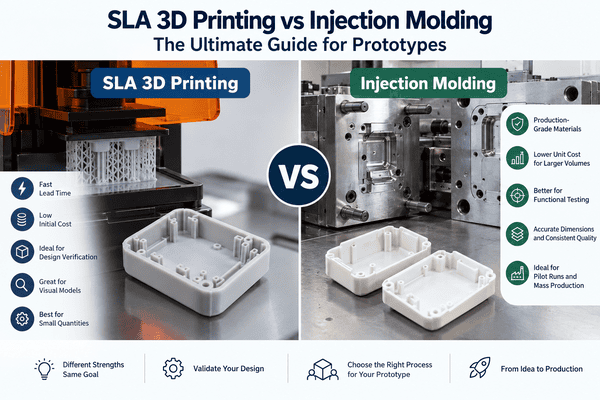
When engineers need prototype plastic parts, they often compare SLA 3D printing vs injection molding. Both methods can make useful prototypes, but they are best for different stages.
SLA is a good choice for fast visual models, fit checks, and small quantities. Injection molding is more useful when the prototype must use production-grade plastic or support functional testing.
The right choice depends on quantity, material, part design, lead time, surface needs, and what you need to test before production.
When Should You Choose SLA 3D Printing vs Injection Molding?
The choice between SLA 3D printing vs injection molding should start with one question: what does the prototype need to prove?
If you only need a few parts to check size, shape, or basic assembly, SLA is often faster. It does not need a mold, so engineers can move from CAD to a physical part quickly.
However, the situation changes when the prototype must behave like the final product.
SLA uses photopolymer resin. It can create smooth and detailed parts, but the material does not behave exactly like ABS, PC, PA, PP, or POM.
This matters when you need to test snap fits, heat resistance, repeated loading, chemical resistance, or long-term use.
In these cases, prototype injection molding can provide parts made from the intended production material. This gives engineers more useful test data before full production tooling.
Is SLA Better for Early Design Verification?
Usually, yes.
SLA works well when the design is still changing. Engineers can test several versions without changing a mold.
Typical uses include:
- appearance review;
- basic assembly checks;
- ergonomic testing;
- size confirmation;
- internal design review;
- customer samples.
For example, an electronics company may print three housing designs before choosing one for tooling.
At this stage, speed is often more important than production-level material behavior.
When Does Injection Molding Become More Useful?
Injection molding becomes more useful when the team needs realistic part behavior.
For example, a snap-fit housing may look fine in CAD and work as an SLA model. But the final plastic may shrink, flex, and assemble in a different way.
A molded prototype lets the team check:
- real shrinkage;
- gate position;
- weld lines;
- warpage;
- ejection;
- surface appearance;
- assembly force;
- dimensional stability.
If the next decision depends on real production behavior, molding gives better data.
How Do SLA and Injection Molding Compare in Cost?
The cost difference in SLA 3D printing vs injection molding mainly comes from tooling.
SLA has almost no tooling cost. Injection molding needs a mold before the first part can be made.
This means SLA usually has a lower starting cost.
However, SLA does not always have the lowest total cost.
As quantity increases, the total printing cost also increases. Every part still needs printer time, resin, cleaning, support removal, and curing.
Injection molding starts with a higher tooling cost. But once production begins, the part cost can fall quickly.
| Factor | SLA 3D Printing | Prototype Injection Molding |
|---|---|---|
| Initial tooling cost | Very low | Higher |
| Cost for 1–10 parts | Usually lower | Usually higher |
| Cost for larger batches | Rises quickly | More competitive |
| Material cost per part | Relatively high | Often lower |
| Design changes | Easy | May need mold changes |
| Best use | Early prototypes | Functional testing and pilot runs |
At What Quantity Does Injection Molding Start to Make Sense?
There is no fixed number for every project.
A small and simple part may justify prototype molding at a lower quantity. A large or complex part may need a higher quantity before molding makes sense.
The break-even point depends on:
- part size;
- mold complexity;
- material;
- surface finish;
- cavity number;
- tolerance;
- quantity;
- future production plan.
For example, if a buyer needs only five housing samples for a design meeting, a mold may not make sense.
But if the buyer needs 300 functional samples for testing and pilot production, prototype molding becomes more attractive.
This is why quantity should always be included in the RFQ.
Should Buyers Compare Only the Prototype Cost?
No.
A low prototype price can be misleading if the test does not answer the real engineering question.
For example, an SLA part may cost less than a molded part. But if the project needs to test a PP living hinge, the printed resin may not give useful results.
In that case, the lower sample price does not reduce project risk.
A better approach is to compare the cost of getting useful test data, not only the cost of one part.
Which Process Gives Better Material and Functional Testing?
For material testing, SLA 3D printing vs injection molding can give very different results.
SLA parts use cured resin. Injection molding can use the same thermoplastic planned for production.
That difference affects strength, flexibility, heat resistance, impact behavior, surface finish, and long-term durability.
For this reason, molded prototypes usually give better data when the final product will also be injection molded.
Fentor Mold uses prototype injection molding for design validation when a project needs real molded material behavior before production tooling.
Can SLA Accurately Test Snap Fits and Flexible Features?
It can help with basic geometry, but the results have limits.
Snap fits depend on material stiffness, elongation, wall thickness, radius, and strain.
Printed resin may be more brittle than the final plastic.
So an SLA prototype may show whether two parts fit together, but it may not show:
- true assembly force;
- repeated snap performance;
- long-term stress;
- fatigue life;
- cracking risk.
Injection molding gives better results when the final part uses ABS, PP, PC/ABS, or PA.
What About Surface Finish and Cosmetic Testing?
SLA can make very smooth parts, so it works well for visual review.
However, a smooth printed surface is not the same as a molded surface.
Injection molded appearance depends on:
- mold polishing;
- texture;
- gate position;
- flow direction;
- weld lines;
- gloss;
- shrinkage;
- material color;
- process settings.
If the customer needs to approve the final appearance, molded samples give more useful information.
How Do Lead Time and Design Changes Affect the Decision?
Lead time is one of the biggest differences in SLA 3D printing vs injection molding.
SLA can produce parts quickly because there is no tooling stage. Engineers can also update the CAD file and print a new version.
Injection molding needs more steps.
The process may include:
- DFM review;
- mold design;
- material preparation;
- CNC machining;
- EDM and finishing;
- mold assembly;
- mold trial;
- sample inspection.
Because of these steps, prototype tooling takes longer.
However, it also gives more production-level information.
What Happens If the Design Is Still Changing?
If the design may still change a lot, SLA is usually the safer choice.
For example, a customer may still be changing:
- outer shape;
- hole position;
- connector location;
- wall thickness;
- internal layout.
It is usually better to confirm these features before cutting steel.
Once the design is stable, a molded prototype can test final manufacturing details.
A common path is:
CAD → SLA prototype → design revision → prototype mold → T1 → production mold
Not every project needs every step, but this process can reduce late changes.
How Does T1 Improve Validation?
T1 gives the team the first real molded parts from the prototype tool.
At this stage, engineers can review both the part and the molding process.
They can check:
- filling;
- venting;
- cooling;
- shrinkage;
- ejection;
- warpage;
- dimensions;
- assembly.
A proper injection mold trial process helps move the project from first samples toward stable production.
T1 can reveal problems that an SLA model cannot show.
How Should Engineers Choose the Right Prototype Process?
The best way to compare SLA 3D printing vs injection molding is to define what the prototype must prove.
Do not start with the process.
Start with the test goal.
| Engineering Goal | Better Starting Choice |
|---|---|
| Check appearance | SLA |
| Check basic fit | SLA |
| Review ergonomics | SLA |
| Produce 1–10 samples | SLA |
| Test real thermoplastic | Injection molding |
| Test snap fit performance | Injection molding |
| Evaluate shrinkage | Injection molding |
| Check gate or weld lines | Injection molding |
| Produce a pilot batch | Injection molding |
| Prepare for mass production | Injection molding |
What Information Should Be Included in an RFQ?
A good prototype RFQ should include more than a 3D model.
Buyers should provide:
- 3D CAD data;
- 2D drawing if available;
- material;
- quantity;
- surface requirement;
- critical dimensions;
- tolerance;
- prototype purpose;
- future production volume.
This information helps the supplier recommend the right process.
For example, if a customer needs 500 prototype parts and plans to use ABS in production, injection mold manufacturing may be worth reviewing earlier.
What Is a Practical Engineering Decision Process?
A simple decision process has four steps.
First, define the test.
Decide whether the prototype is for appearance, assembly, function, material testing, or pilot production.
Second, confirm the quantity.
Five samples and 500 samples may need very different processes.
Third, check how important the final material is.
If the real thermoplastic matters, printing may not give enough information.
Fourth, look at the next production stage.
If the product will soon move into molding, prototype tooling may reduce the gap between prototype and production.
At Fentor Mold, this type of review helps us decide whether a customer should stay with a fast prototype method or move to molded validation.
FAQ About SLA 3D Printing vs Injection Molding
Is SLA 3D Printing Cheaper Than Injection Molding?
For a few parts, SLA is usually cheaper because there is no mold cost.
However, printing cost rises as quantity grows. Prototype injection molding needs tooling, but the unit cost can become lower for larger batches.
So buyers should compare total project cost, not only the first-part price.
Can SLA Parts Replace Injection Molded Prototypes?
Sometimes, but not for every test.
SLA is good for shape, appearance, and basic fit checks.
It is less useful when engineers need to test real production material, shrinkage, snap-fit life, molded defects, or final assembly behavior.
If these factors affect approval, molded prototypes give better data.
Is Prototype Injection Molding Only for High Quantities?
No.
Prototype molding can also make sense at lower quantities when function matters more than volume.
For example, a medical housing, automotive clip, or industrial connector may need realistic material behavior even if the project only needs a small batch.
Can You Use SLA First and Injection Molding Later?
Yes.
This is often a practical approach.
SLA can help confirm the early design. Once the design is stable, prototype injection molding can test real material behavior and manufacturing risk.
This can reduce the chance of building tooling too early.
What Comes After Prototype Injection Molding?
After the team approves dimensions, function, material, and assembly, the project can move toward production tooling.
At that stage, engineers can optimize cavity number, cooling, mold steel, cycle time, automation, and mold life.
Conclusion
The choice between SLA 3D printing vs injection molding depends on what the prototype must prove.
SLA is usually better for early design checks and very small quantities. It is fast and easy to change.
Injection molding becomes more useful when engineers need real thermoplastic behavior, production-like surface quality, dimensional checks, functional testing, or a pilot batch.
For many projects, the best path is to use SLA while the design is changing, then move to molded prototypes when function and production behavior matter more.
If you are preparing a plastic prototype project and need help choosing the right process, contact us with your 3D data, material, quantity, and test requirements.