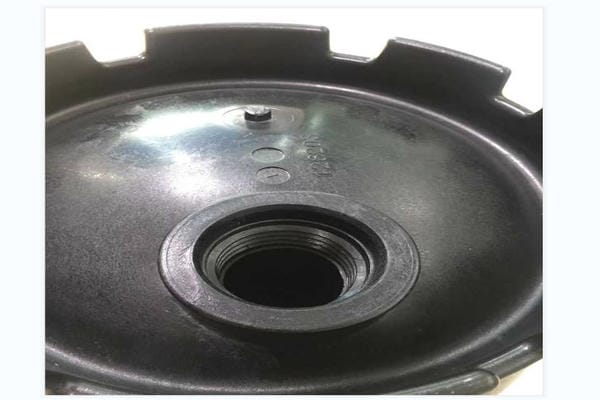
Internal undercuts can make a plastic part difficult or impossible to eject from a normal mold core. Threads, internal grooves, locking rings, and recessed features may trap the part after cooling. A collapsible core injection mold solves this problem by reducing the core diameter before ejection. This creates enough clearance for the plastic part to release. However, the mechanism also adds cost, wear, and maintenance needs. Engineers should therefore use it only when the part geometry and production requirements truly need this type of solution.
When Should You Use a Collapsible Core Injection Mold?
A collapsible core injection mold works well when an internal undercut runs around most or all of the inside diameter of a molded part. A normal straight core cannot release this type of feature because the plastic locks around the steel.
Typical applications include:
- internal circular grooves;
- locking rings;
- internal threads;
- bottle caps;
- connectors;
- pipe fittings;
- medical parts;
- cylindrical housings.
The main advantage is simple: the undercut can often release in the normal mold opening direction.
This may reduce the need for several side sliders around the part.
Still, a collapsible core should not be the first answer for every internal undercut. During DFM, engineers should first check whether the feature can be redesigned or released with a simpler mold structure.
Our guide on how to design undercuts in injection molded parts explains other options before choosing a complex core system.
How Does a Collapsible Core Injection Mold Work?
A collapsible core injection mold normally uses several core segments around a center pin or actuator.
During injection, the segments stay fully expanded. Together, they form the final internal shape of the plastic part.
After cooling, the mold starts the ejection sequence. The center mechanism moves first. This allows the outer core segments to move inward.
As the segments collapse, the core diameter becomes smaller.
Once the undercut clears the steel, the ejector system can push the part forward.
The basic sequence is:
- Mold closes.
- Core segments expand.
- Plastic fills the cavity.
- The part cools.
- Mold opens.
- The core mechanism moves.
- Segments collapse inward.
- The undercut clears the steel.
- The part ejects.
- The core returns to its molding position.
Timing is very important. If the part ejects before the core fully collapses, the plastic feature may crack. The core may also suffer damage.
How Much Undercut Can a Collapsible Core Release?
There is no single limit.
The answer depends on core diameter, undercut depth, segment movement, steel strength, plastic material, and available mold space.
A deeper undercut needs more inward movement.
However, the core segments cannot become too thin. They still need enough steel to handle injection pressure and repeated cycles.
Engineers should review:
- core diameter;
- undercut depth;
- molded feature width;
- number of core segments;
- core length;
- plastic shrinkage;
- available ejection stroke;
- steel strength.
A small-diameter part with a deep undercut can be harder to mold than a larger part with the same undercut depth.
Why Choose a Collapsible Core Injection Mold Instead of a Lifter or Slider?
A collapsible core injection mold is often the better choice when a lifter or slider cannot release a continuous internal feature.
Sliders work well for side undercuts. Lifters are useful for local internal undercuts. Collapsible cores are more suitable when the feature runs around the inner diameter.
For example, imagine a round plastic connector with a locking groove around the full inner wall.
One lifter cannot form the full groove. Several lifters may work, but they can create extra split lines and more moving parts.
A collapsible core can form the whole profile with one central mechanism.
| Mold Solution | Best Use | Movement | Main Limitation |
|---|---|---|---|
| Slider | External side undercut | Sideways | Needs side space |
| Lifter | Local internal undercut | Upward + sideways | Limited area |
| Collapsible core | Circular internal undercut | Inward | Higher complexity |
| Unscrewing core | Internal thread | Rotation | Longer cycle |
Our lifter vs slider injection mold guide explains where those systems work better.
When Is a Lifter Better Than a Collapsible Core Injection Mold?
A lifter is often simpler when the undercut is only in one small area.
For example, one snap hook on the inside wall of a housing may only need one lifter.
In that case, a collapsible core injection mold would add cost without giving much benefit.
A lifter may also be easier to machine and maintain.
Choose a lifter first when:
- the undercut is local;
- the feature does not run around the full diameter;
- enough ejection stroke is available;
- a small split line is acceptable;
- the mold should stay simple.
When Is an Unscrewing Core Better?
Internal threads need a separate review.
Some thread designs can use a collapsible core. Others cannot.
Long threads, deep threads, or tight thread forms may need an unscrewing mechanism.
An unscrewing core rotates out of the plastic part.
This usually needs extra components such as gears, racks, hydraulic drives, or servo systems.
That can increase cycle time and maintenance.
The final decision should compare thread geometry, mold cost, cycle time, quantity, and long-term reliability.
What Makes a Collapsible Core Injection Mold Difficult to Design?
A collapsible core injection mold needs more engineering than a normal fixed core. Several moving steel segments must form one accurate molding surface and then collapse smoothly after every cycle.
The main risks are:
- weak core segments;
- poor alignment;
- limited cooling space;
- wear;
- incorrect ejection timing;
- unstable return position.
For this reason, DFM should happen before mold design starts.
At Fentor Mold, our injection mold manufacturing process reviews the part structure, undercut direction, cooling, ejection method, and mold movement before machining begins.
How Do You Keep the Core Strong?
Collapsible segments can become thin in complex designs.
This creates a strength risk.
During injection, molten plastic pushes against the steel. If a core segment is too thin, it may bend, crack, or wear quickly.
It may also lose dimensional accuracy.
Engineers should keep enough steel around critical areas.
Sharp steel corners should also be avoided where possible because they create stress points.
For high-cycle molds, steel grade and heat treatment become more important.
The goal is to combine wear resistance with enough toughness for repeated movement.
Why Is Segment Alignment So Important?
Every segment must return to the same position before the next shot.
Poor return can cause:
- witness lines;
- dimensional variation;
- flash;
- damaged edges;
- difficult mold closing.
The guide surfaces and center actuator must therefore position the segments accurately.
Machining quality also matters.
These parts may need CNC machining, EDM, wire EDM, grinding, and careful fitting.
Our article on injection mold core and cavity machining explains why machining accuracy directly affects mold fit and part quality.
How Should Cooling Be Designed?
Cooling is often harder in a collapsible core injection mold.
A solid core gives more room for drilled water lines. A collapsible core has moving parts inside, so space is limited.
Poor cooling can lead to:
- longer cycle time;
- more shrinkage;
- warpage;
- unstable dimensions;
- high core temperature.
Cooling should therefore be planned early.
In some molds, standard drilled water lines may not reach the hottest areas. Engineers may need alternative cooling methods.
How Should a Collapsible Core Injection Mold Be Tested at T0 and T1?
A collapsible core injection mold needs careful testing during T0 and T1 because the mechanism has more moving parts than a standard mold.
The first trial should check more than dimensions.
The team should also confirm:
- full core expansion;
- stable segment position;
- correct opening sequence;
- full collapse before ejection;
- smooth part release;
- no internal scratches;
- no flash between segments;
- full core return.
A structured injection mold trial process is especially useful for complex mold mechanisms.
What Problems Can Appear During the First Trial?
One common issue is that the part stays too tight on the core.
Possible causes include:
- not enough collapse movement;
- high plastic shrinkage;
- low draft;
- rough steel surface;
- part deformation;
- wrong ejection timing.
Another common issue is a witness line between core segments.
A light line may be acceptable on some internal features. However, flash or a large step usually means the segments do not fit or return correctly.
The mold maker should first check machining, fitting, pressure, and movement.
Simply polishing the edges may not solve the real problem.
Why Should You Run More Than a Few Trial Shots?
A mechanism may work well for five slow shots but behave differently after the mold heats up.
Steel expands with temperature. Lubrication also changes during a longer run.
For this reason, T1 or T2 should include enough cycles to check:
- thermal expansion;
- repeat movement;
- part sticking;
- ejection stability;
- wear marks;
- lubrication;
- cycle repeatability.
This gives a better view of long-term production performance.
How Should Buyers Review a Collapsible Core Injection Mold During RFQ?
When an RFQ includes a collapsible core injection mold, buyers should not compare mold price alone.
A lower-cost design may use weaker steel, simpler guidance, or less reliable moving parts.
These choices can increase maintenance cost later.
The supplier should explain why a collapsible core is needed and whether another solution is possible.
Useful RFQ information includes:
- 3D part data;
- 2D drawing;
- plastic material;
- annual quantity;
- mold life;
- tolerance;
- appearance requirements;
- expected machine size;
- production location.
What Should Be Checked Before Mold Design Approval?
Before steel cutting, review:
- core structure;
- collapse direction;
- collapse distance;
- ejection sequence;
- core steel;
- segment thickness;
- cooling;
- lubrication points;
- spare parts;
- sensor needs.
This review can prevent expensive changes later.
For high-volume molds, spare core components may also be worth preparing in advance.
How Does a Collapsible Core Affect Production Cost?
A collapsible core injection mold usually costs more than a standard mold.
However, it may reduce the need for several sliders or an unscrewing system.
The real cost should include:
Tooling cost + cycle time + maintenance + part quality + mold life
For example, a more expensive collapsible core may still make sense if it reduces mold size and removes several hydraulic sliders.
For a simple low-volume part, the same design may not be economical.
Once the mold enters injection molding production, reliability becomes just as important as the original mold price.
FAQ About Collapsible Core Injection Molds
Can a Collapsible Core Injection Mold Make Internal Threads?
Yes, some internal threads can use a collapsible core injection mold.
However, the thread profile, depth, pitch, diameter, and plastic material must allow enough core collapse.
Long or deep threads may need an unscrewing system instead.
Does a Collapsible Core Leave Marks on the Part?
It can leave small witness lines where the core segments meet.
Good machining and fitting can keep these lines very small.
Whether they are acceptable depends on the part function and appearance requirements.
Is a Collapsible Core Suitable for High-Volume Production?
Yes, if the design is strong and stable.
High-volume use needs good steel, accurate guidance, proper lubrication, stable cooling, and regular maintenance.
Wear parts should also be easy to inspect and replace.
Is a Collapsible Core Expensive?
It usually costs more than a fixed core because it uses multiple precision parts.
However, it can still be cheaper than several sliders or a full unscrewing system.
The correct choice depends on part design and production volume.
Conclusion
A collapsible core injection mold is a practical solution for circular internal undercuts, locking grooves, internal threads, and other features that cannot release from a normal fixed core.
The core collapses inward before ejection. This gives the plastic part enough clearance to release.
However, the mechanism adds design and maintenance requirements. Core strength, segment alignment, cooling, wear, and ejection timing all need careful control.
Before choosing this structure, engineers should compare it with lifters, sliders, product redesign, and unscrewing systems.
If your part has a difficult internal undercut and you need help reviewing the mold concept, contact us with your 3D data and project requirements.